Prepaid Return Labels: The 7-Day Rule
Amazon Prepaid Return Labels from 18 December 2026, and Whether the Label Is Worth Sending
From 18 December 2026, an address-only return label stops counting for US seller-fulfilled orders. Within seven calendar days of a return request you upload a prepaid label inside Amazon’s returns workflow — or refund in full and let the buyer keep the item. Miss the window and Amazon refunds from your account. This guide covers the rule, the exemptions, and the per-SKU maths of which choice actually pays. Updated November 2026.
Introduction
This guide is for sellers who ship their own Amazon orders in the US — full FBM sellers, hybrid FBA/FBM sellers with a merchant-fulfilled offer somewhere in the catalogue, and Seller Fulfilled Prime sellers. If every order you sell is FBA, Amazon already runs your returns end to end and this rule does not touch you. If you ship even one product yourself, it does.

From 18 December 2026, Amazon removes the cheapest way of handling a seller-fulfilled return: the address-only label, where you tell the buyer where to send the item and the buyer pays the postage. From that date, almost every US seller-fulfilled return needs a prepaid return label, uploaded against the return request inside Amazon's Manage seller-fulfilled returns workflow, within 7 calendar days of the request — or a full refund with no return at all. Do neither in time, and Amazon may issue that returnless refund itself and deduct the money from your selling account, while the buyer keeps the product.
Most coverage of this change stops at the rule. The rule is the easy part. The harder question — the one this guide spends most of its length on — is the decision the rule forces on you, return by return: for this item, at this price, is the label worth sending, or should you refund and let the buyer keep it? Get that decision right per SKU and the new rule costs you very little. Get it wrong — or worse, make no decision and let requests age past day seven — and the rule quietly takes the most expensive option on your behalf, every time.
A note on sources before we start. This change was announced in an Amazon Services email to sellers and a Seller Forums post, not (yet) in Amazon's public help pages, which were still silent on it weeks after the announcement. Where this guide quotes the rule, it quotes Amazon's announcement text as reproduced by seller publications. Where it talks about label prices, it says so plainly: Amazon has published no label price list for this rule, and every number in that discussion is a labelled estimate. Confirm the wording against your own Seller Central account before you rebuild your process around it.
In 60 seconds
- What changes: from 18 December 2026, address-only return labels stop meeting Amazon's requirement for US seller-fulfilled returns. A prepaid label becomes the default.
- Your two compliant options: within 7 calendar days of a return request, either upload a prepaid return label against the request in Manage seller-fulfilled returns, or issue a full refund without requiring the item back.
- The trap: a label sent through Buyer-Seller Messaging does not count. Neither does an emailed label link or a tracking number pasted into a message. Only the upload inside the returns workflow stops the clock.
- If you miss the window: Amazon may automatically issue a returnless refund and deduct it from your account. The buyer keeps the item. You lose the sale and the unit, on Amazon's timing, not yours.
- The exemption: heavy and bulky items are temporarily exempt — but Amazon has published no size or weight threshold and no end date, so don't assume your products qualify.
- The money decision: retrieving a unit is worth it only when its expected resale value beats the label plus your handling cost. On a $12 item with an $8.40 rural label, it usually doesn't. On a $30 or $80 item, it usually does. Section 5 works all three.
- Not the same change: this is separate from February 2026, when Amazon ended the high-value exemption from its prepaid label programme. Section 2 untangles the two, because sellers are gluing them together and planning wrong.
1. What actually changes on 18 December 2026
Amazon's announcement is short enough to quote directly, and worth reading in Amazon's own words rather than in summary:
"Starting December 18, 2026, all US returns for seller-fulfilled orders (excluding heavy and bulky items) will require a prepaid return shipping label. Address-only labels that require customers to pay for return shipping will no longer meet the requirement, except temporarily for heavy and bulky items. This change allows for a consistent process for your US and international returns and helps improve the customer experience."
And the compliance mechanics, again in Amazon's words:
"To meet the requirement, within seven calendar days of a return request, you must either: upload a prepaid return shipping label against the return request on the Manage seller-fulfilled returns workflow, or issue a full refund without requiring customer to return the item. If a prepaid return label or returnless refund isn't provided within this timeframe, a returnless refund may be automatically issued and the balance deducted from your selling account."
Four things in that text deserve more attention than they've been getting.
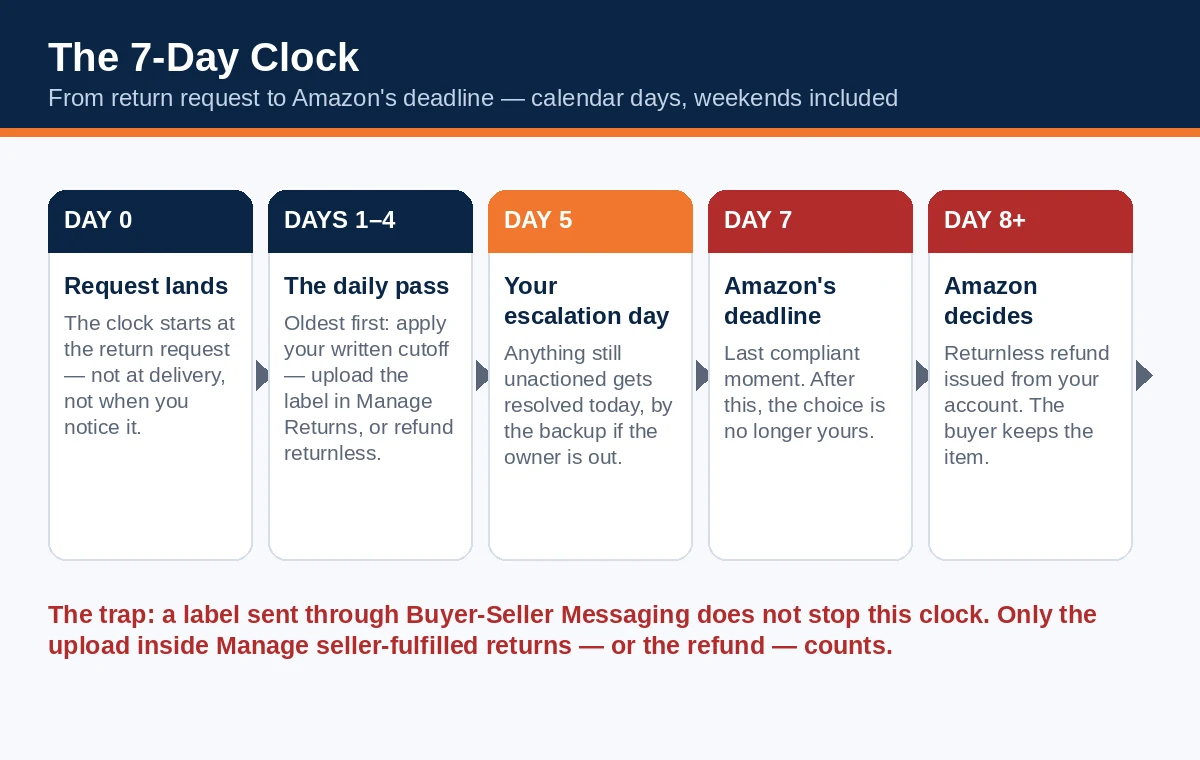
First, the clock starts at the request, not at the delivery, the authorisation, or the day you notice it. Seven calendar days means weekends and holidays count. A request that lands on the Friday before a holiday weekend can be on day four before anyone on your team has seen it. Section 6 builds the daily workflow this implies.
Second, the request date controls, not the order date. Amazon moderators have clarified that a return requested on or after 18 December is covered even if the order shipped weeks earlier. With Amazon accepting returns on holiday orders placed between 1 November and 31 December until 31 January, the practical effect is that most of your holiday return wave lands under the new rule, and the refunds can keep arriving into February.
Third, for most sellers, most returns will not change at all. US sellers are already automatically enrolled in Amazon's prepaid return programme: for the majority of returns, Amazon generates the prepaid label itself through Buy Shipping and charges your account for the return shipping once the buyer actually sends the item back, priced from the weight and size data on your listing. Amazon has confirmed those Amazon-generated labels continue, and return eligibility is unchanged. What 18 December kills is the residue: the returns you still handle with an address-only label, a label you create by hand, an exempt-category workflow, or instructions sent to the buyer in a message. If that's a small share of your returns today, this change is a tidy-up. If it's how you handle returns generally, it's a rebuild.
Fourth, the two options are not equal, and Amazon knows it. The label gets your product back; the returnless refund doesn't. When Amazon issues the refund for you after a missed deadline, it picks the returnless option — the one where you lose the unit — because that's the option that closes the request. Every missed deadline is Amazon choosing the most expensive outcome on your behalf. That asymmetry is the whole economics of this rule, and it's why the decision framework in Section 5 matters more than the compliance mechanics.
One more piece of timing context: 18 December falls inside USPS's 2026 peak-season rate window (4 October 2026 to 17 January 2027), which covers services like Ground Advantage and Priority Mail. The labels you buy during the transition will be priced at seasonal rates — one more reason the per-SKU maths in Section 5 should be done with your real label costs, not last summer's.
2. Two different changes that sellers keep gluing together
A lot of the confusion around this rule — including some confident coverage — comes from merging the December change with a separate change Amazon made in February 2026. They involve the same programme and different mechanics. Keep them apart, because they demand different responses.
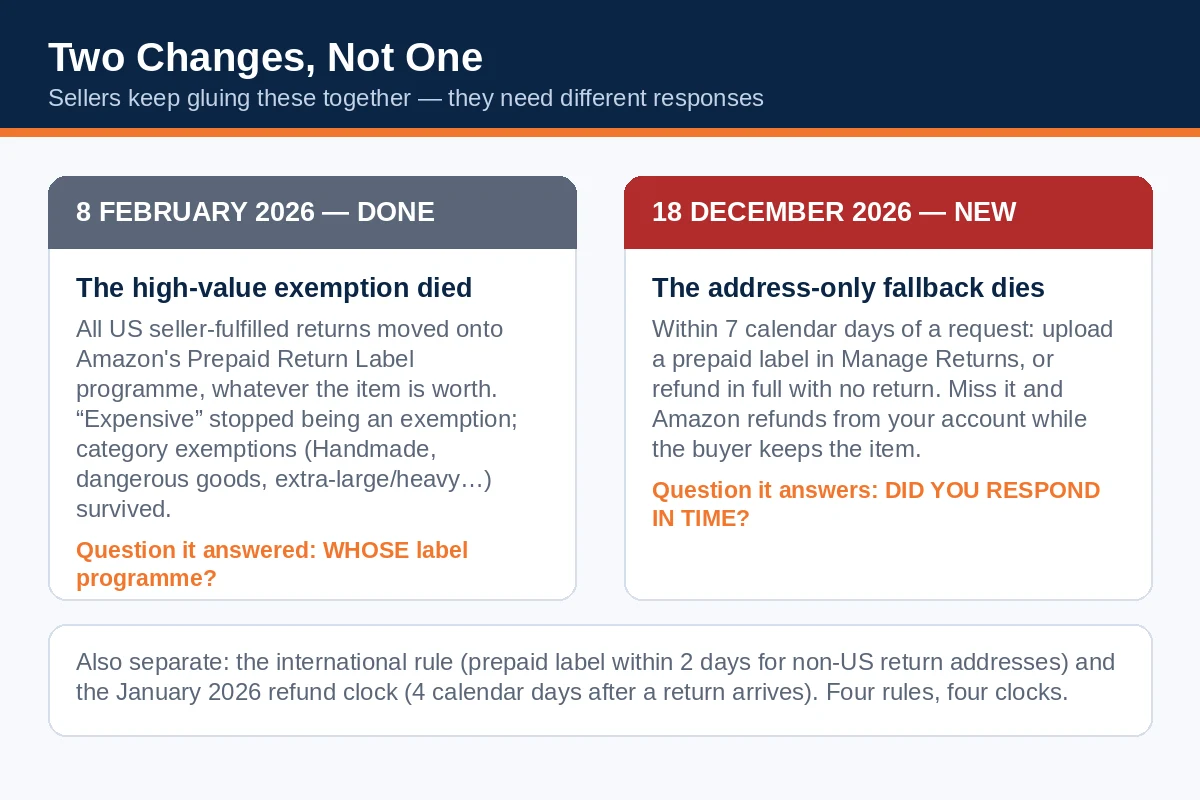
The February 2026 change (already in force): the high-value exemption died. Until 8 February 2026, sellers of high-value items could opt out of Amazon's Prepaid Return Label programme for those products and manage return shipping themselves — with their own carrier rates, their own insurance, their own return address. From 8 February 2026, that exemption was eliminated: all US seller-fulfilled returns use Amazon's prepaid labels regardless of item value. Trade-press coverage of the February change also reported that Amazon's prepaid labels carry a $100 insurance cap — a real exposure if you sell jewellery, watches or electronics FBM, and worth verifying against your own account terms, because a $500 item returned damaged on a label insured to $100 leaves a gap no claim will close. What did not die in February: the standing category exemptions (Handmade, certified pre-owned watches, non-physical items, dangerous goods, extra-large or heavy items — see Section 3). "Expensive" stopped being an exemption. Categories kept theirs.
The December 2026 change (this guide): the address-only fallback dies. February decided whose label programme your returns travel on. December decides what counts as responding to a return request at all: a prepaid label uploaded in the workflow within seven days, or a full returnless refund. A seller can be fully compliant with February — every return on an Amazon prepaid label — and still fall foul of December, by letting a request that needs their action sit unanswered for eight days.
Two neighbouring rules complete the untangling, because they share vocabulary with both changes:
- The international rule is older and faster. Returns where the buyer has a non-US return address have required a merchant prepaid label through Manage seller-fulfilled returns within 2 days of the request — or a returnless refund, or a valid US domestic return address in your settings — for some time. Amazon's stated logic for December is aligning domestic returns with that existing international standard. Track the two clocks separately: 2 days international, 7 days domestic.
- The refund clock changed in January 2026. Separately again, Amazon moved the seller-fulfilled refund processing window to four calendar days before an automated refund may be triggered, and adjusted how SAFE-T eligibility applies to some automatic refunds. That clock governs what happens after a return arrives. The seven-day clock in this guide governs what happens before — whether a label or a refund goes out at all. Both can be running on the same return.
| Date | Change | What it actually did |
|---|---|---|
| 26 Jan 2026 | FBM refund processing update | Refund window moved to 4 calendar days before an auto-refund; SAFE-T eligibility adjusted for some automatic refunds |
| 8 Feb 2026 | High-value exemption ended | All US seller-fulfilled returns on Amazon's prepaid label programme, whatever the item's value |
| 18 Dec 2026 | Address-only labels end | Prepaid label uploaded in Manage Returns within 7 calendar days of a request, or a full returnless refund — or Amazon refunds for you |
If your preparation so far has been "we already use Amazon's prepaid labels, so we're covered," you've handled February. December is about response time and decision-making, and it needs its own process.
3. Who is exempt — and the heavy-and-bulky fog
The December announcement names exactly one exemption: heavy and bulky items, and it calls that exemption temporary. Amazon's notice gives no size threshold, no weight threshold, and no end date. That vagueness is itself the fact to plan around:
- Do not borrow a definition from elsewhere. FBA size tiers and carrier "oversize" definitions are not Amazon's test for this exemption — seller publications that checked found no published threshold to point at. If your account treats an item as heavy and bulky, that's your evidence; a 50 lb carrier rule is not.
- Do not build a permanent process on it. A temporary exemption with no end date can end the same way it arrived — by email. If heavy and bulky is your whole returns strategy, you have a strategy with an unknown expiry date.
Separately, Amazon's prepaid return programme has standing category exemptions that predate this rule and are not what December is about. Per Amazon's prepaid-returns guidance, these are automatically exempt from the mandatory prepaid-label programme, no request needed: Handmade; certified pre-owned watches; non-physical items (warranties, digital software, digital coupons); items that are non-returnable by law and dangerous goods; and extra-large or heavy items. Sellers can also request an exemption for specific SKUs outside those categories, and even for an exempt SKU you can still choose to provide a prepaid label through Manage Returns.
Two cautions belong here. First, exempt from the label programme is not the same as exempt from responding: return requests on exempt items still sit inside Amazon's wider returns machinery, with its own authorisation and refund clocks. Second, category treatment is exactly the kind of detail to verify in your own Seller Central rather than from any guide — a forum thread from the February change shows a Handmade seller who was issued prepaid labels despite the Handmade exemption and had to chase Seller Support to get the treatment corrected. Check how your SKUs are actually classified before 18 December, not after your first contested return.
4. What a label actually costs — and who finally pays for it
This is the section where most coverage gets sloppy, so let's separate two questions that are usually merged into one wrong sentence.
Question one: what does a return label cost? Amazon's December notice publishes no price, and there is no rate card for seller-uploaded return labels. What exists are estimates, and this guide labels them as such:
- Around $8.40 for a light rural return. A Handmade seller posting on Amazon's own forums put their rural return label at $8.40 — on a $12 item, which meant $16.80 of shipping across the round trip and, in their words, a $4.80 loss before fees, materials and labour. That figure lines up with a published rate: since July 2026, a sub-1 lb USPS Ground Advantage parcel to a rural Zone 8 destination bills at the 15.99 oz Commercial rate of $8.40. One seller's number and one published carrier rate — useful for planning, not an Amazon price list.
- Around $12–$18 for mid-range items. Ordoro's policy roundup puts prepaid labels "at $12 to $18 for mid-range items" — again, an estimate from a fulfilment platform, not a quote for your products.
Your real number depends on weight, dimensions, distance and carrier, and Amazon calculates the charge on its generated labels from the weight and size data on your listing — which makes accurate listing data a cost control, not housekeeping. An overstated shipping weight on a listing is now a per-return overcharge, forever, until someone fixes it.
Question two: who finally bears that cost? Here the honest answer is: it depends, and any source that tells you "the seller always pays" (or "the buyer pays") is simplifying. "Prepaid" describes how the label is provided — postage arranged in advance — not who ultimately funds it. The moving parts:
- Where Amazon generates the label, the return shipping charge lands on your seller account once the buyer ships the item back. That part is mechanical.
- Amazon's existing returns guidance ties the final cost to the reason for the return. A return caused by your error — wrong item, defective, not as described — is your cost in a way a buyer's change of mind is not, and Amazon's rules allow the label cost to be deducted from the buyer's refund in buyer-fault cases.
- Programme enrolment overrides things: sellers offering Free Returns, and fashion returns under their own restrictions, cannot deduct return shipping on in-policy returns regardless of this change.
- The December notice itself does not rewrite any of that. It mandates the label; it does not declare every return seller-funded.
So the working rule is: plan your maths on the assumption that the label cost is yours (Section 5 does exactly that — it's the conservative case), then check your return reasons and programme settings to see where deductions legitimately claw some of it back. And keep the restocking-fee route in its proper place: for buyer-damaged items, Amazon's restocking rules cap reimbursement at 50% of the order value and give you an appeal path with photos, the label, tracking and proof of delivery. That machinery is unchanged by December — but it only exists for items that actually come back, which is one more input into the decision we turn to now.
5. The money decision: send the label, or refund and let them keep it?
Every covered return request from 18 December is the same small business decision, made under a seven-day clock:
- Send the label and you spend the label cost plus your handling cost — receiving, inspecting, repacking, relisting — to get the unit back and resell it.
- Refund returnless and you spend nothing more, but the unit is gone. Whatever it could have resold for is forgone.
The refund itself cancels out of the comparison: the buyer is refunded in full on both routes. What you're really comparing is the net recovery from retrieving the unit:
Net recovery = expected resale value of the returned unit − label cost − handling cost
If that number is positive, send the label. If it's negative, the returnless refund is cheaper — issue it yourself, on day one, rather than letting Amazon issue it on day eight. Expected resale value is the honest part of the formula: not the list price, but what a returned unit realistically resells for — list price times a recovery percentage that reflects open-box discounting, condition risk and the share of returns that arrive unsellable.
Three worked examples, using the labelled estimates from Section 4:
| $12 item | $30 item | $80 item | |
|---|---|---|---|
| Label cost (estimate) | $8.40 (rural, light) | $13.00 (mid-range) | $16.00 (mid-range, heavier) |
| Handling: receive, inspect, relist | $3.00 | $4.00 | $5.00 |
| Total cost to retrieve | $11.40 | $17.00 | $21.00 |
| Expected recovery | 60% | 75% | 85% |
| Expected resale value | $7.20 | $22.50 | $68.00 |
| Net recovery | −$4.20 | +$5.50 | +$47.00 |
| Decision | Refund returnless | Send the label | Send the label |
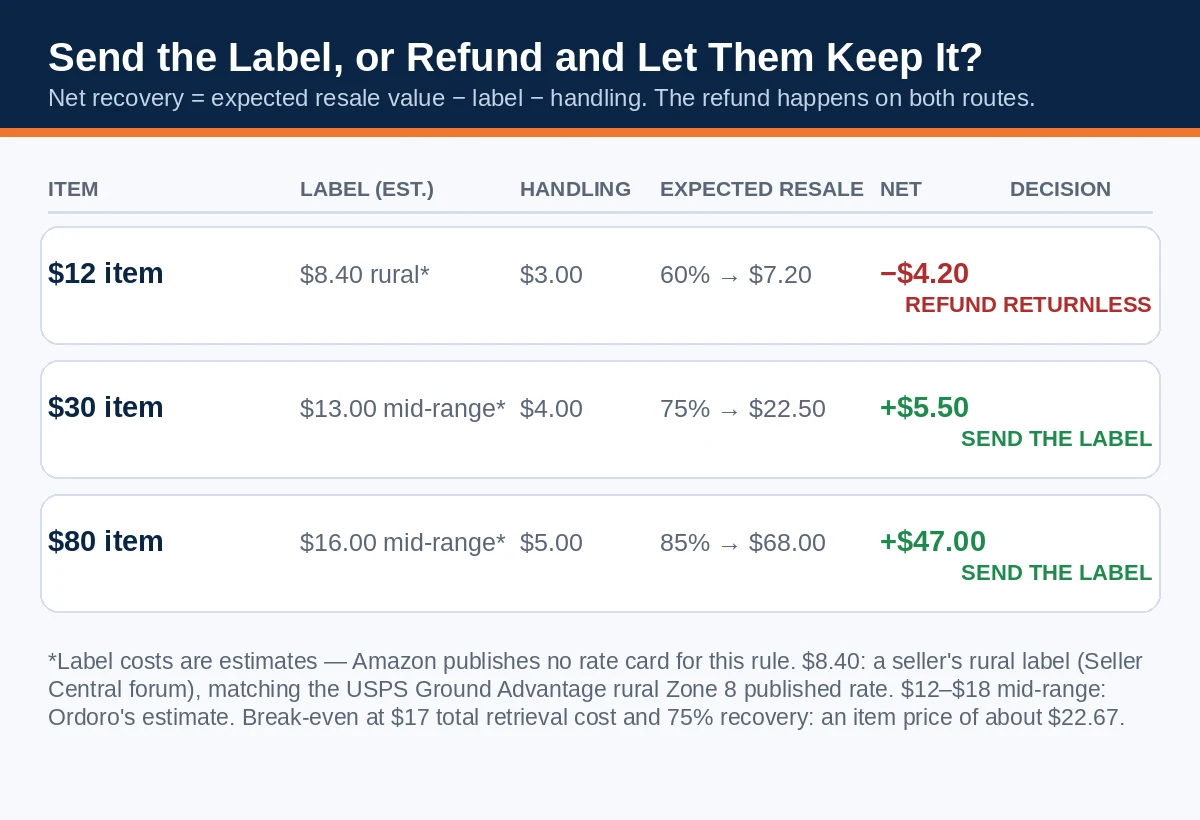
The $12 item. Retrieval costs $11.40 to recover a unit you expect to resell for $7.20. Sending the label loses $4.20 more than refunding on the spot. This is the forum seller's trap made precise — at low prices, rural postage alone can exceed the recovered value, and the label becomes a way of paying to get your own loss back. Note the break-even recovery rate here is 95%: the returned unit would have to resell at essentially full price for the label to pay. Cheap, light, low-recovery items are returnless-refund items. Decide that in advance, per SKU, and the seven-day clock stops mattering for them — the refund goes out on day one and the request closes.
The $30 item. Retrieval costs $17.00 against an expected $22.50 back — the label wins, but by $5.50, not by a landslide. This is the band where your real numbers decide: if your actual label quote is $18 rather than $13, or your recovery rate is 55% rather than 75%, the answer flips (the break-even recovery rate at these costs is about 57%). Mid-priced items are where the worksheet at the end of this guide earns its keep, because gut feel is genuinely unreliable here.
The $80 item. Retrieval costs $21.00 against $68.00 expected back. The label wins by $47, and it isn't close — the break-even recovery rate is only about 26%, so even a badly knocked-around return is worth retrieving. For higher-value items the risk runs the other way: the expensive mistake is the missed deadline, because a forced returnless refund throws away the whole $68 recovery to save a $16 label.
That last point generalises, and it's the comparison almost nobody publishes. Take the $30 example and miss the deadline: Amazon refunds returnless, the unit is gone, and your net recovery is $0 instead of +$5.50 — annoying. Miss it on the $80 item and you forfeit $47 of recovery. An independent worked example in seller coverage (a $60 order, $20 unit cost, $11 label) lands in the same place: label sent on time, you're out $11 and hold the unit; deadline missed, you're out the $20 unit — $9 worse, before you count the lost resale. The deadline doesn't punish you with a fine. It punishes you by making your worst option mandatory. Which is why Section 6 treats the workflow as seriously as the maths.
Three refinements before you set your own cutoffs:
- Set the cutoff per SKU, in writing, before 18 December. The decision inputs — price, typical label cost, recovery rate — are stable per product. A written cutoff ("under $15 and under 70% expected recovery: refund on sight") turns a daily judgement call into a daily execution task, which is what a seven-day clock rewards.
- Use your worst realistic label cost, not your average. Returns come from wherever buyers live. If a third of your buyers are rural, the rural label price is a planning number, not an edge case.
- Revisit when inputs move. Label prices are seasonal (peak rates run to 17 January), recovery rates drift with product quality and listing accuracy, and prices change. A cutoff set in November deserves a fresh look in February.
6. The 7-day SOP: a daily workflow that never misses
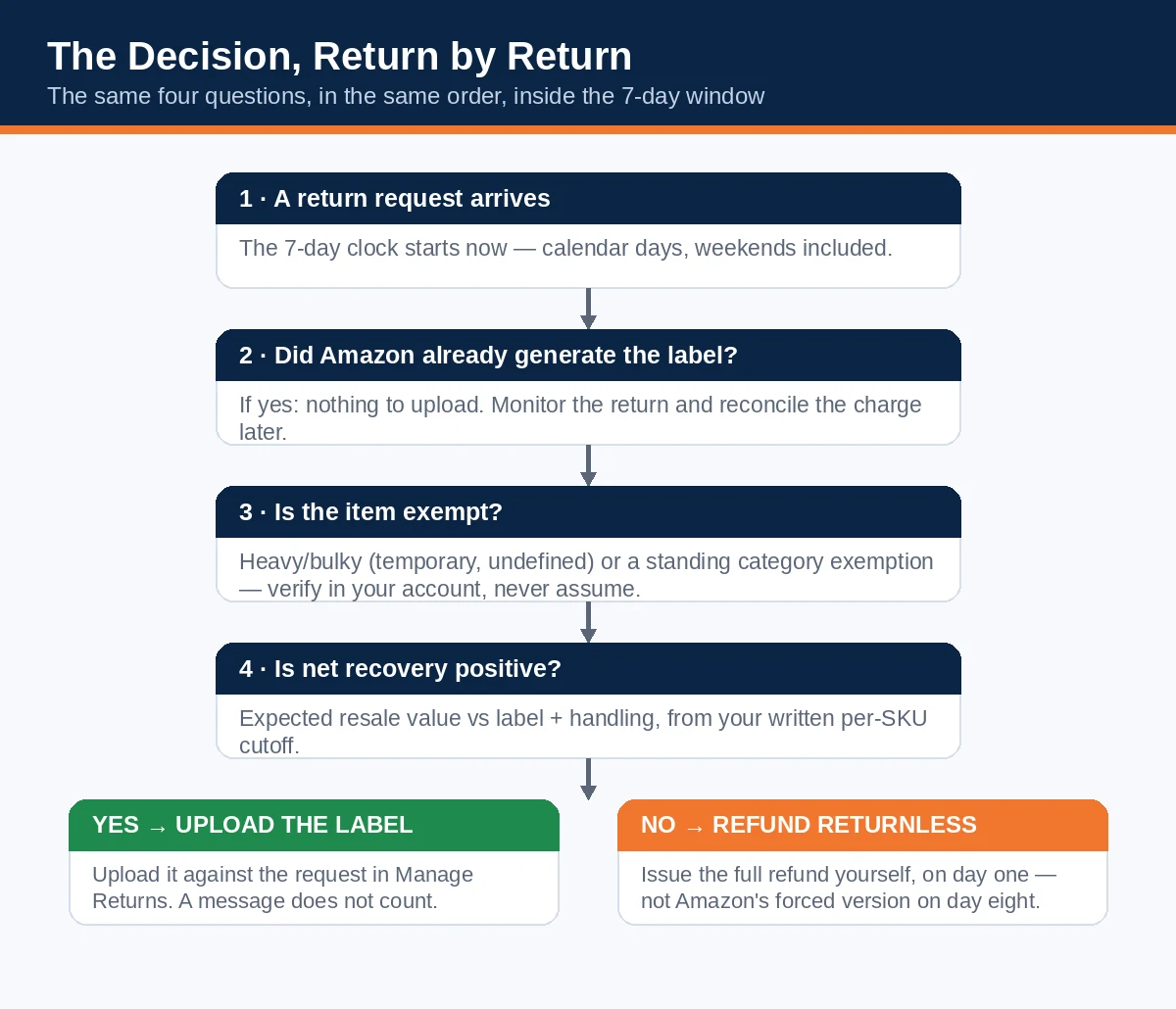
The rule punishes drift, not defiance. Nobody plans to ignore a return for eight days; requests get missed because returns are checked twice a week, or by one person who takes a holiday, or in a queue nobody sorted by age. The fix is a small, boring, daily routine. This is the one this guide recommends — it is also the companion checklist to this article, so you can run it as a checklist rather than a memory test.
Assign an owner and a backup, by name. One person owns Manage seller-fulfilled returns daily; a second person covers weekends, holidays and absence. Seller coverage of this rule keeps landing on the same recommendation because the failure mode is always the same: the request aged while its owner was away. If you use a fulfilment partner or a 3PL, agree in writing who watches the queue, who buys and uploads labels, who can approve a returnless refund, and where returns are received. Using a partner does not move the requirement off your account.
Run the same pass every day, oldest first.
- Open Manage seller-fulfilled returns and sort by request age. Work the oldest requests first, not the newest. Anything already at day five or older is today's emergency, whatever else is in the queue.
- Split the queue into three piles. (a) Amazon already generated the label — nothing to upload; note it and move on. (b) Requests needing your action on covered items — these carry the seven-day clock. (c) Exempt or unclear items — heavy/bulky candidates, special categories — flagged for verification, not assumed exempt.
- Apply your written cutoffs. For each request in pile (b), run the Section 5 decision: SKUs on your returnless list get their full refund issued immediately; the rest get a prepaid label bought and uploaded against the request in the workflow.
- Verify the submission, not the intention. A bought label is not a submitted label. A message to the buyer is not a submitted label. The job is done when the label shows against the return request inside Amazon. This is the single most expensive misunderstanding in the whole rule — a seller can buy the label, send it to the buyer, do everything except the upload, and still be refunded by Amazon on day eight.
- Log it. Date, request, action taken, who acted. Thirty seconds per request. The log is what lets you spot a pattern — a SKU whose returns spike, a week where the queue aged — before it becomes a month of forced refunds.
Escalate before the deadline, not at it. Set your internal trigger at day five: any covered request still unactioned at day five gets resolved the same day, by the backup if the owner is out. Day seven is Amazon's deadline; it should never be your working deadline.
Keep the neighbouring clocks separate. The seven-day label clock does not replace the others: return categories needing manual authorisation still need a response within 24 hours, and refunds are still due within two business days of a return arriving. One queue, three clocks — the daily pass above is where all three get checked.
Reconcile weekly. Amazon charges generated-label costs to your account when buyers ship. Match the week's return charges in your settlement and payments reports against your log, and check the label costs against your Section 5 assumptions. If actual labels are running $3 above your planning figure, your cutoffs are wrong and February-you will pay for November-you's optimism.
7. Getting ready before 18 December
You have a month. The preparation is a half-day of work, most of it audit:
- Sort your FBM catalogue by how returns are labelled today. Amazon-generated label, address-only label, hand-made label, message-based instructions. Everything in the last three groups needs a new route before 18 December. This audit — not the rule itself — is the real size of your problem.
- Check your exemption position per SKU. Which items sit in the standing exempt categories? Which are you assuming are heavy and bulky, and does your account actually treat them that way? Where a SKU matters and its status is unclear, verify in Seller Central or request a per-SKU exemption — before the first contested return, not during it.
- Fix your weight and size data. Amazon prices its generated labels from your listing data. Wrong dimensions now cost you on every return, in both directions: overpaying on labels, and carrier adjustment charges when the real parcel disagrees with the label.
- Confirm your return address. Prepaid returns have to land somewhere that can receive, match items to orders and RMAs, inspect and restock. An outdated return address can see returned items treated as abandoned.
- Write your returnless cutoffs. Per SKU or per price band, using Section 5: price, your realistic label cost, your honest recovery rate. Signed off before the holiday rush, so December decisions are execution, not debate.
- Do one test run. Take a live return request through the full workflow — buy the label, upload it against the request, confirm the submission shows in Amazon. The time to discover your process has a hole is during a test, not during the Christmas return wave.
- Brief whoever touches returns. Anyone who might answer a buyer message should know the one sentence that matters: a label in a message does not count. Well-meaning staff "helping" a buyer with a label link are how compliant sellers end up refunded by Amazon.
Frequently asked questions
Does this apply to FBA orders?
No. FBA returns run through Amazon's own returns process, as they always have. The rule covers US seller-fulfilled orders — FBM, hybrid FBA/FBM offers, and Seller Fulfilled Prime.
Can I just message the buyer a label? It would be faster.
Faster, and non-compliant. Amazon's announcement states it directly: labels shared through Buyer-Seller Messaging or any channel outside the Manage Returns workflow don't meet the requirement. The request stays open, the clock keeps running, and on day eight Amazon can refund the buyer from your account while your perfectly good label sits in a message thread.
What about orders shipped before 18 December?
They can be covered. Amazon moderators have clarified that the buyer's return-request date controls: a return requested on or after 18 December falls under the rule even if the item shipped in November. Combined with holiday returns being accepted until 31 January, expect the rule to bite from its first week.
Amazon already generates prepaid labels for my returns. Do I need to do anything?
For those returns, no — Amazon-generated labels continue, and eligibility is unchanged. Your exposure is the residue: any returns you still handle with address-only labels, hand-made labels or message instructions, plus making sure requests that do need your action get it within seven days.
Who pays for the label — me or the buyer?
It depends on the return reason and your programme settings, whatever the simpler explainers say. The label charge lands on your account when the buyer ships; Amazon's rules allow the cost to be deducted from the refund in buyer-fault cases, but Free Returns offers and fashion restrictions block that deduction on in-policy returns. Section 4 works through it. Plan your maths as if the cost is yours; treat any deduction as a clawback, not a given.
What exactly counts as "heavy and bulky"?
Amazon hasn't said. The exemption is real, temporary, and undefined — no published weight or size threshold, no end date. Don't borrow FBA size tiers or carrier definitions as a substitute; verify how your own products are treated in your account, and don't build a permanent process on an exemption Amazon can end by email.
If Amazon refunds a buyer because I missed the deadline, can I claim it back through SAFE-T?
Unknown — and be wary of anyone who tells you otherwise. Amazon has not said whether SAFE-T claims cover refunds triggered by a missed label deadline. Its returns help pages mention SAFE-T for some Amazon-issued refunds, and a January 2026 update changed SAFE-T eligibility for some automatic refunds, but the missed-deadline case is not confirmed either way. Treat any such refund as a loss you prevent with the workflow in Section 6, not a loss you recover afterwards.
I sell internationally too. Is it the same deadline?
No. Returns with a non-US return address already work to a 2-day version of this rule — prepaid label through Manage Returns, a returnless refund, or a valid US return address in your settings. The 7-day clock is the new domestic one. Two clocks, tracked separately.
Over to you
The sellers who will feel this rule are not the ones who disagree with it. They're the ones whose returns process is a person checking a queue when they remember to. Eighteen December turns return handling from a chore into a clock — but it also hands you a genuinely useful forcing function: decide, per SKU, what a returned unit is actually worth to you, and write it down. That decision was always where the money was. Amazon has just started charging sellers who never made it.
If you run FBM alongside FBA, do the audit this week while it's still cheap: sort your catalogue by label method, write your cutoffs, run one test upload. The rule itself is seven days long. The preparation is an afternoon.
Read next
- The Returns Double Hit: Amazon’s Frequently Returned Badge, the Returns Processing Fee, and How to Bring Your Return Rate Down (2027 Guide) — the FBA mirror of this problem: the other place a return rate quietly taxes you, and how to bring the number itself down.
- Amazon Deactivated Your FBM Offer? The New Offer-Level Rules, the Four Metrics, and How to Get It Back (2027 Guide) — the other 2026 FBM change: how a single bad offer can now be switched off on its own, and the weekly routine that prevents it.
Returns handled? The other half of the ledger is reviews.
The same operations discipline that keeps returns inside the window also drives your feedback, your defect rate and your review profile. The 2027 playbook maps every compliant way to build reviews — and the shortcuts that end accounts.