Amazon’s $1M Insurance Rule
The COI Audit for Sellers Who Missed 2 November
Since 2 November 2026, any listing in an enhanced-safety category — children’s products, cosmetics, ingestibles, lithium-battery goods — needs $1 million of liability cover at any sales level. The $10,000 threshold no longer protects you, and the deadline has passed. This guide is the 15-minute self-check: find out whether you’re caught, then audit your certificate against the six points Amazon actually rejects on. Updated November 2026.

Introduction
This guide is for sellers on Amazon's US store who list — or have ever listed — products in Amazon's enhanced-safety categories: children's products, cosmetics, ingestibles, lithium-battery products and their neighbours. It is especially for the seller who read the headline, did a quick mental calculation — "I don't sell $10,000 a month, so this isn't me" — and moved on. Since 2 November 2026, that calculation is wrong. The sales threshold no longer protects you. Category does the deciding now, and the deadline has already passed.

So this is a "you may already be non-compliant" guide. Its core is a 15-minute self-check: five minutes to find out whether any of your ASINs sits inside the new perimeter, ten minutes to audit your certificate of insurance (COI) against the six points Amazon actually rejects certificates on. If you have no policy, the same audit becomes your shopping list — the specification to hand an insurer so the certificate you pay for is the one Amazon accepts.
One scope note before we start. The failure mode this guide is built around is not ignorance of the rule — sellers have heard of the rule. It is rejection: a real policy, paid for, whose certificate bounces because the name is a DBA, the form is claims-made, or Amazon appears in the certificate-holder box instead of as an additional insured. In Amazon's own forums, the most useful reply on the insurance thread is a peer-written checklist of exactly those wording traps. This guide turns that checklist into an audit — and is honest about where the public record runs out, starting with the full category list, which Amazon keeps behind a login.
In 60 seconds: the rule, the deadline and the audit on one screen
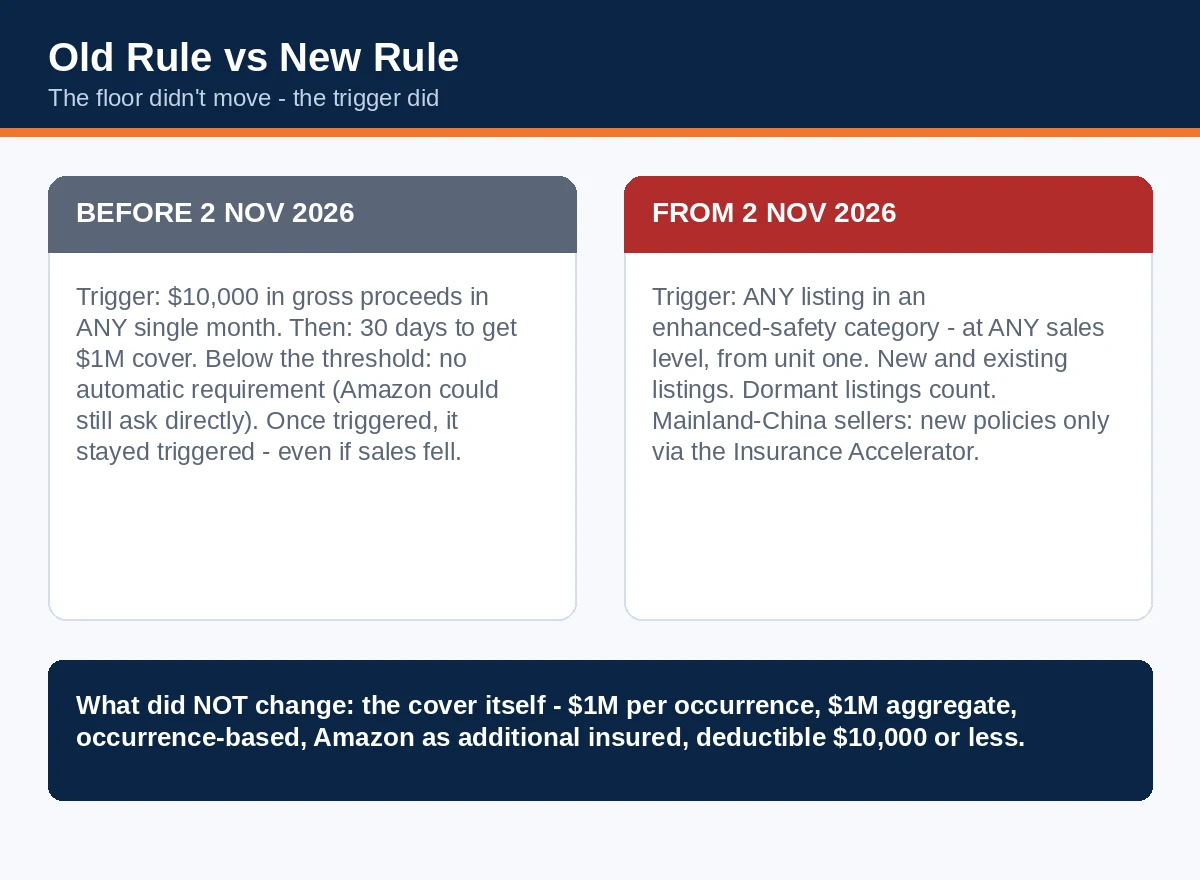
- What changed: until 2 November 2026, Amazon's insurance trigger was money — cross $10,000 in gross proceeds in a month and you had 30 days to get $1M of cover. Since 2 November, any listing in an enhanced-safety category triggers the same requirement at any sales level, from your first unit.
- The cover itself didn't change: at least $1 million per occurrence and $1 million in the aggregate, occurrence-based, including products/completed operations, with "Amazon.com Services LLC and its affiliates and assignees" named as additional insured and a deductible of $10,000 or less.
- The deadline has passed. The rule is in force now. Seller publications that covered Amazon's notice report that Amazon emails sellers it identifies and gives them 45 days from that email to submit proof, after which enhanced-safety listings can be deactivated until proof is on file — but that timetable is reporting, not a promise, and the only deadline that binds is the one in your own email (Section 5).
- Based in mainland China? Since 2 November, Amazon rejects newly submitted policies that didn't come through the Amazon Insurance Accelerator. A valid policy submitted before 2 November runs until it expires; after that, the Accelerator is the only door (Section 4).
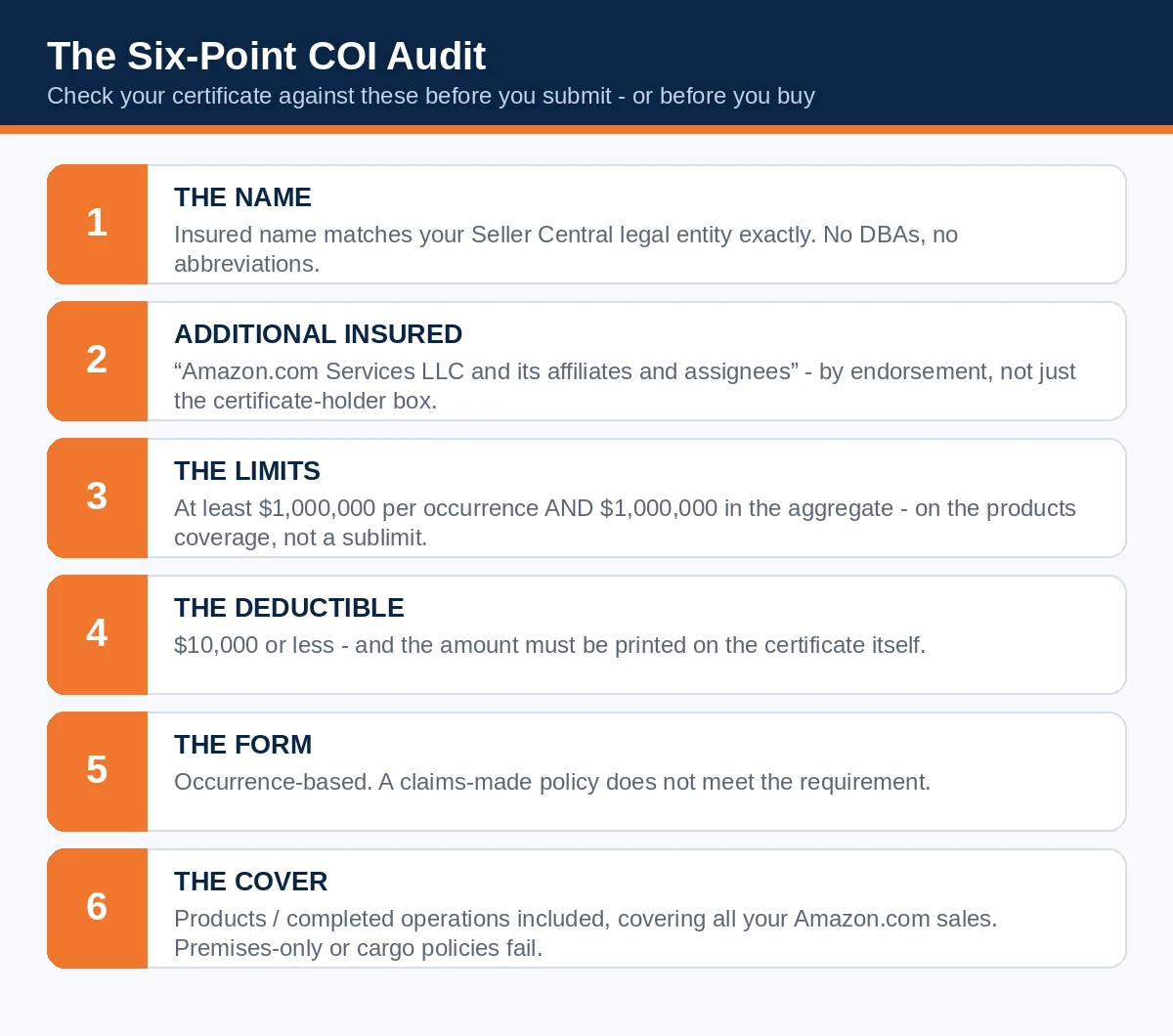
- The audit is six points: the insured name matches your legal entity exactly; Amazon is an additional insured by endorsement, not just certificate holder; limits are $1M/$1M; the deductible is ≤ $10,000 and printed on the certificate; the policy is occurrence-based; and it covers your products (products/completed operations) across all your Amazon.com sales.
- The cost is usually smaller than the fear. Sellers in Amazon's forums report paying about $36 a month (one seller, online insurer) and $800 a year (one seller, local agent) — individual reports, not benchmarks, but a useful corrective to the five-figure numbers in agency marketing (Section 6).
1. What changed on 2 November — and the misconception it killed
The old rule, which still exists. Under section 9 of the Business Solutions Agreement, a US-store seller must obtain and maintain commercial liability insurance within 30 days of exceeding $10,000 in gross proceeds in any month, with minimum coverage of $1 million per occurrence and in the aggregate. Two details were already widely misunderstood before November. First, it is any month — one viral December triggers it, not a sustained average. Second, once triggered it does not switch off when sales fall: the obligation runs for the remainder of your selling agreement. And Amazon has always reserved the right to demand proof at any time, at any volume. The threshold was the automatic trigger, never a guaranteed exemption.
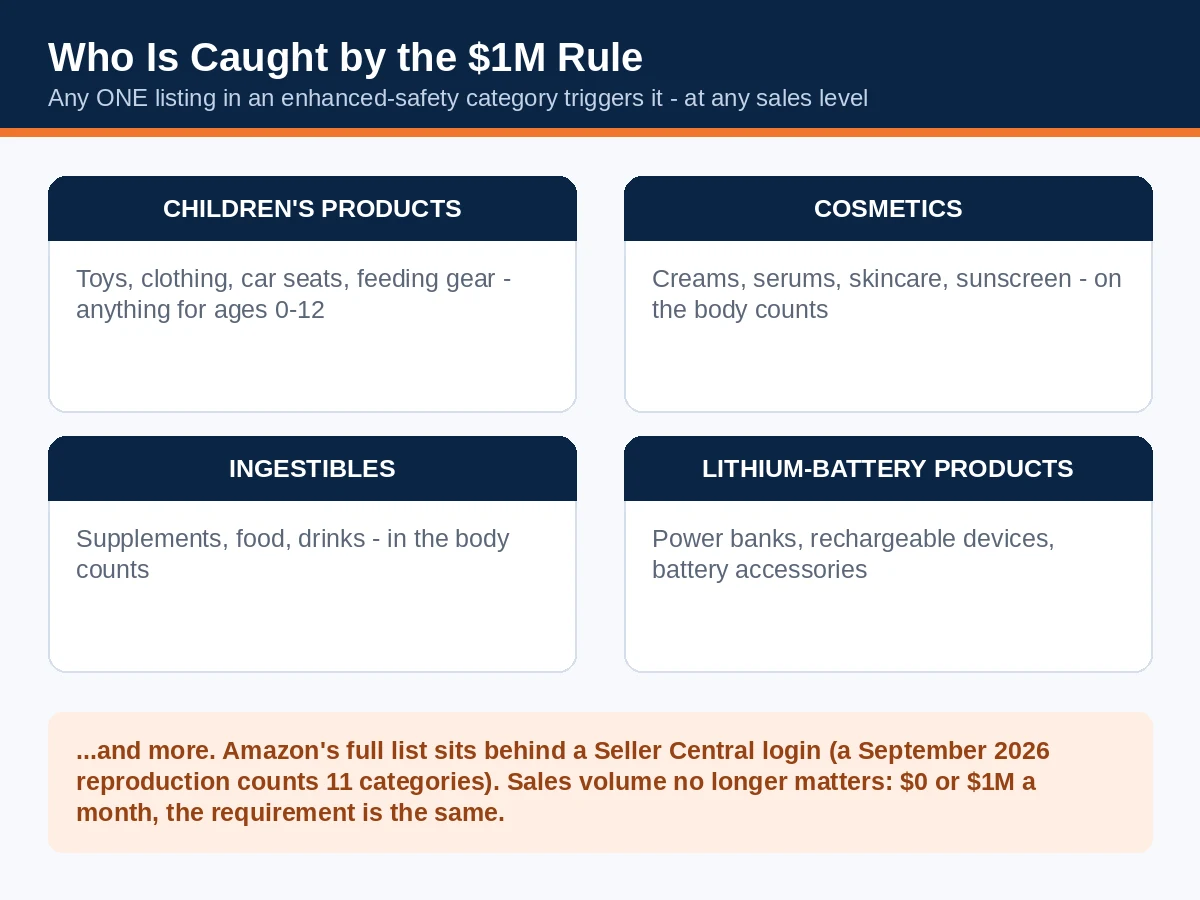
The new rule. On 3 September 2026 Amazon posted a notice to its US Seller Forums: from 2 November 2026, sellers with products listed in categories that carry enhanced safety listing requirements must maintain a commercial liability policy covering those products — "regardless of whether they meet the USD 10,000 gross proceeds in a month threshold." The change "applies to both new and existing listings." The floor did not move: the same $1M/$1M. What moved is the trigger — from how much you sell to what you sell.
The misconception it killed. Amazon's insurance forum thread contains the old thinking in a single line, from a seller averaging about $6,000 a month for two years: "do I still have to carry liability insurance?" Under the old rule, that seller's honest answer was "not unless Amazon asks you directly." Under the new rule, the answer depends on a question that seller wasn't asking: what is in the catalogue? If one listing — one — is a children's product, a cosmetic, an ingestible or a lithium-battery product, the threshold is irrelevant. A dormant listing counts. A listing that sells three units a month counts. The requirement attaches to the listing's category, and the policy has to cover those products.
Why Amazon did it is stated plainly in the notice: the changes are meant "to help protect Amazon's customers as well as help you protect your business from financial loss in the event of a product-related incident." Read alongside the categories named — things children use, things people put on or in their bodies, things that store energy in lithium cells — the logic is not mysterious: these are where a product incident becomes an injury claim, and Amazon wants a seller's insurer behind every listing in them from the first sale, not the ten-thousandth dollar.
What did not change matters just as much, because it is where the rejections live. The specification in Section 3 — the wording, the limits, the deductible cap, the occurrence form — is Amazon's standing requirement, in force long before this deadline. Sellers who already carry compliant cover mostly need to verify, not buy; everyone else needs to buy against a spec insurers do not all meet by default. Either way, the work is the audit.
2. The 15-minute self-check, part 1: is one of your ASINs inside the perimeter?
Set a timer. This half takes about five minutes, and decides whether the rest of the guide applies to you.
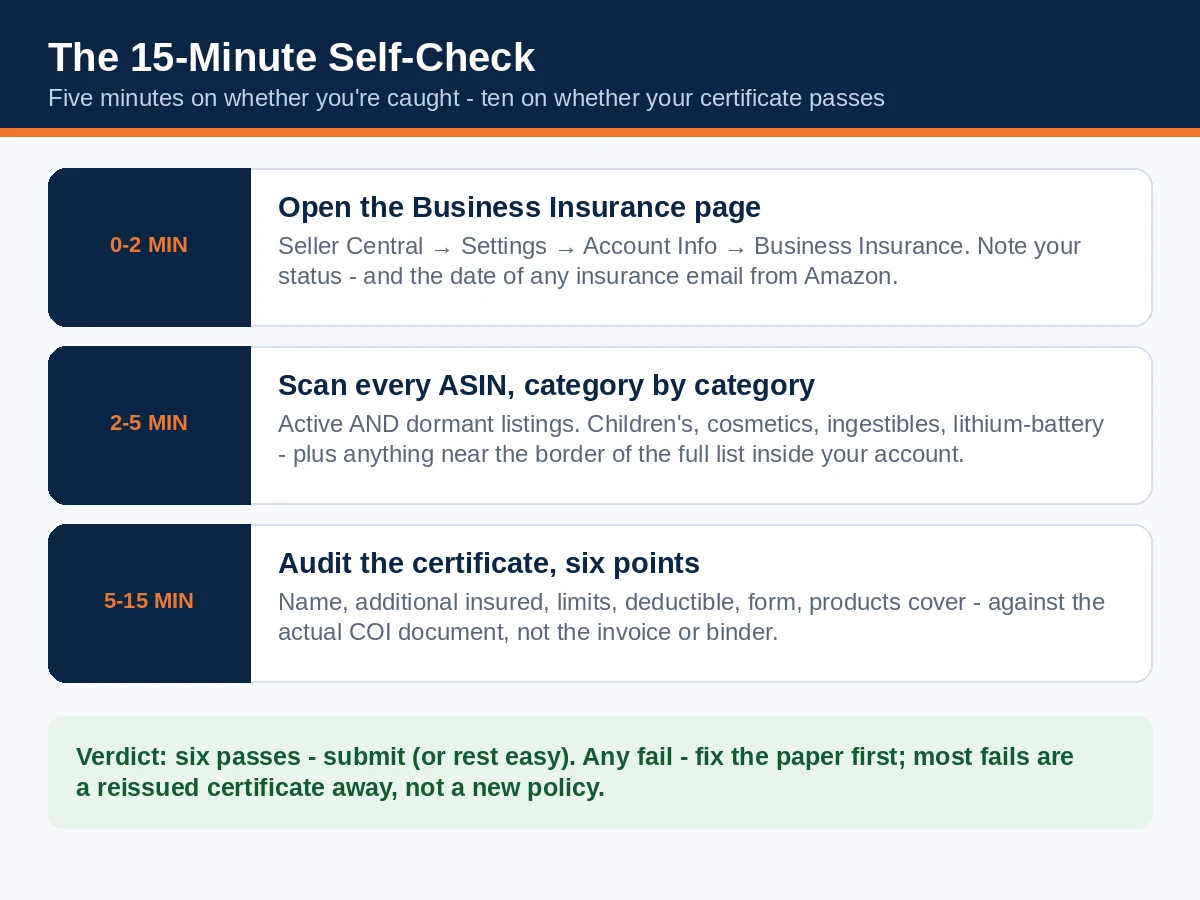
Step 1 — Start from Amazon's flag, not your memory. Go to Seller Central → Settings → Account Info → Business Insurance — the page where Amazon records your insurance status and where certificates are submitted. If Amazon has already identified your account as needing cover, it shows there. Check your notifications and email for an insurance request while you are there — and if you find one, note its date. It matters in Section 5.
Step 2 — Walk your catalogue ASIN by ASIN. The trigger is the category of each listing, so the check is a listing-by-listing scan, not a vibe. Amazon's notice names children's products, cosmetic and ingestible products, and lithium battery products — and states that the affected categories "include, but are not limited to" those. Ask of each active listing: is this for children? Does it go on or in the body? Does it contain or charge a lithium battery? Then — the step sellers skip — check your inactive and dormant listings too. The rule covers existing listings; a paused children's product from 2024 still counts.
Step 3 — Accept that the definitive list is behind a login, and use yours. The honest limitation, stated plainly because too much coverage pretends otherwise: Amazon's full list of enhanced-safety categories sits on a Seller Central page that requires sign-in. It is not in the public notice. A reproduction of that page, published in September 2026 by SellerEssentials from inside Seller Central, counts eleven categories — the three Amazon names publicly, plus fire-related products, household devices including small kitchen appliances, home medical devices, outdoor power and heating equipment, personal safety equipment, sleep products such as mattresses, transport-related products such as tyres, and water and marine safety products. Treat that reproduction as a good map, not the territory: other lists circulating online differ from it, Amazon says its named examples are not exhaustive, and the list can change. The binding version is the one inside your account. If an ASIN sits anywhere near the border of that map — a kitchen appliance, a mattress, a tyre, a helmet — check it properly rather than assuming you're out.
Step 4 — Watch the classification, not just the product. The trigger follows how Amazon's systems classify the listing, and sellers in the announcement discussion raised the obvious friction immediately: the same product can be treated as a supplement in one catalogue placement and a grocery item in another — an herbal tea is the example they used. Check the category and product type on each borderline ASIN; "my competitor's listing isn't flagged" is not evidence about yours.
The verdicts. If no listing — active or dormant — is in or near an enhanced-safety category, you're under the $10,000 threshold, and Amazon has not asked you directly: this rule does not currently reach you. Keep the audit anyway; the day you launch a product in one of these categories, it reaches you from unit one. If even one ASIN is inside the perimeter, you need compliant cover for those products, and you are already past the date. Move to Part 2.
3. Part 2: the six-point COI audit
Take out your certificate of insurance — the actual document, not the invoice and not the binder. (Amazon wants a complete, signed COI; binders, endorsements, bills and invoices are not accepted in its place.) If you have no policy, read this section as a purchase specification: the list to hand an insurer before money moves. Ten minutes, six points.
Point 1 — The name: your legal entity, exactly
The insured name on the policy must match the legal entity name you supplied to Amazon. Not the brand name. Not the store name. Not a DBA, not an abbreviation, not "LLC" dropped because the insurer's form ran out of space. The forum checklist puts it bluntly: no abbreviations, no DBAs. Amazon's requirements note one exception, for single-member LLCs — if that's you, confirm your exact situation rather than assuming a near-match passes. A mismatch is the purest form of rejection: the policy can be perfect in every other respect and still bounce, because on paper it insures somebody else.
Point 2 — The additional insured: the exact line, backed by an endorsement
Your policy must name, as additional insureds, "Amazon.com Services LLC and its affiliates and assignees" — that wording, complete. This is the point that fails most, and it fails in a specific way. A certificate has a certificate holder box; insurers routinely type Amazon's name and address there. That is not the same thing. Certificate-holder status gives Amazon a copy of the paper. Additional insured status gives Amazon standing under the policy — a product claim that names the marketplace can be tendered to your insurer. Amazon requires the second, and it is created by an endorsement to the policy, not by typing on the certificate. The forum guidance is unambiguous: Amazon listed only in the certificate-holder box, without the endorsement behind it, is the single most common reason COIs get declined. Before you submit — and before you pay for a new policy — ask the question that thread recommends, verbatim: "Will you issue a COI naming Amazon.com Services LLC and its affiliates and assignees as additional insured?" If the agent hesitates, keep shopping.
Point 3 — The limits: $1M per occurrence, $1M aggregate
At least $1,000,000 per occurrence and at least $1,000,000 in the aggregate. Per occurrence is the most the policy pays on a single incident; aggregate is the most it pays across the policy period. Both must clear $1M, and they must be the limits on the coverage that includes your products — a policy whose product liability sits in a sublimit below $1M does not meet the requirement because the headline CGL limit does. You will encounter content claiming the aggregate must be $2M. Amazon's requirement, restated in its November notice, is $1M and $1M; this guide follows Amazon.
Point 4 — The deductible: $10,000 or less, and printed
Any deductible cannot exceed $10,000 — and the deductible must appear on the certificate of insurance. Two failure modes: a high-deductible policy bought to cheapen the premium (a $25,000 deductible fails outright), and a compliant deductible that simply isn't shown on the COI, which fails on paper. The second is a five-minute insurer fix: ask for a reissued COI that shows it.
Point 5 — The form: occurrence-based
The policy must be written on an occurrence basis: it covers incidents that happen during the policy period, whenever the claim arrives. A claims-made policy — which responds only to claims first made while it is in force — does not meet the requirement, and JunctionKit's walkthrough calls the form one of the most common rejection reasons. Many inexpensive policies are claims-made or quietly convert at renewal — check the declarations page, not the sales pitch. One narrow exception exists in the record: a seller in the announcement thread posted an Amazon confirmation, dated July 2026, that claims-made policies "are permitted for children's products that are not insurable under an occurrence policy form." The November notice does not mention that carve-out. Treat it as a specific, seller-reported exception to confirm with Amazon for your case — not as general permission to submit a claims-made policy.
Point 6 — The cover: products/completed operations, for everything you list
The policy must cover liabilities arising from your business operations including products, products/completed operations, and bodily injury — in plain terms, product liability must actually be in the policy. A general liability policy that covers your premises and operations but omits products is the classic near-miss: right insurer, right limits, wrong cover. The forum checklist adds two cousins of the same error: premises-liability-only policies, and shipping or cargo policies — neither is product liability. Amazon also requires the policy to cover all sales from products listed on the Amazon.com store, so a policy scoped to your own website's sales, or excluding the enhanced-safety ASINs, fails even if its numbers are right.
The supporting cast. Smaller requirements in Amazon's specification, cheap to verify while the document is open: the policy type must be commercial general, umbrella, or excess liability; the insurer should carry an S&P or AM Best rating of A- or better and handle claims globally (per Marsh's guidance for the Accelerator network); the insurer must give Amazon at least 30 days' notice of cancellation, modification or nonrenewal; and the policy must be valid for at least 60 days from the date you submit it — a certificate uploaded in the last weeks of a term can fail on that alone, so renew before you submit.
Scoring your audit. Six passes: submit, or rest easy if already accepted. Any fail: do not submit and hope — a rejected certificate costs you the review cycle and, if Amazon has given you a date, part of your window. Section 5 is the fix sequence.
4. Based in mainland China? Your route changed too
The November notice carried a second change, narrower and in practical terms harder. From 2 November 2026, sellers based in mainland China must obtain their insurance through the Amazon Insurance Accelerator (AIA) — Amazon's network of pre-vetted insurers, assembled with a broker (Marsh has supported it since 2021), set up to issue policies meeting Amazon's requirements. The enforcement line is precise: "Starting November 2, 2026, we will reject newly submitted insurance policies that are not obtained through AIA."
What that means in practice:
- A policy you already had survives — for now. A valid third-party policy that meets the coverage requirements and was submitted before 2 November can be used until it expires. The grandfathering is real but it is a countdown: at expiry, the replacement must come through the Accelerator.
- A policy bought outside AIA after 2 November will be rejected on submission, however compliant its wording. For a China-based seller, the six-point audit in Section 3 still matters — it is how you check the certificate AIA's insurers issue you — but the shopping question is settled: there is one door.
- Plan the renewal before the expiry. If your grandfathered policy expires in February, open the AIA route in January, not expiry week — an expired policy plus an unsubmitted replacement is exactly the gap this rule punishes.
For sellers based elsewhere, AIA remains one optional route among many, useful because its insurers issue Amazon-shaped certificates by default. Any insurer whose policy passes the audit and meets the rating bar qualifies. One caution from the announcement discussion: a China-based seller reported that individual sellers without a company entity can struggle to buy through the Accelerator. That is one seller's unverified claim, and Amazon has not addressed it — but if it describes you, start early, while you still have time to work the problem.

5. If your certificate would fail: the fix, in order
Work these in sequence. Most sellers are done at step 2.
Step 1 — Fix the paper before you buy anything. Most audit fails are document problems, not coverage problems: the name is a DBA, the endorsement was never added, the deductible isn't printed, the COI is last year's. Every one is fixed by your existing insurer, usually free and within days: "Reissue my certificate with the insured name exactly as [legal entity], add the additional-insured endorsement for 'Amazon.com Services LLC and its affiliates and assignees', and show the deductible on the COI." Send them Section 3's six points as the spec. Do not submit the flawed certificate first "to see" — a rejection just restarts the clock.
Step 2 — If the policy itself is wrong, re-shop against the audit. Claims-made form, products excluded, limits under $1M, deductible over $10,000: these need a new or amended policy, not a new certificate. Take the six points to market as a checklist and ask the Section 3 question — will you issue a COI naming Amazon.com Services LLC and its affiliates and assignees as additional insured? — before discussing price. An insurer who issues Amazon-compliant certificates routinely will treat the question as routine; that reaction is the signal you're shopping in the right place. The Insurance Accelerator is the pre-vetted route for any seller — and the only route for mainland-China-based sellers (Section 4).
Step 3 — Submit through the Business Insurance page, and keep the evidence. Upload the complete, signed COI in Seller Central (Settings → Account Info → Business Insurance). Save the confirmation, the certificate and the declarations page somewhere that is not Seller Central. If the certificate is rejected, the reason maps to one of the six points — fix that point and resubmit, rather than resubmitting the same document hopefully.
Step 4 — Know what clock you're actually on. Here the public record needs handling with care. Amazon's notice, as reported in depth by PPC Land, sets the 2 November effective date but publishes no enforcement timetable. Seller publications that covered the change — Ordoro, SellerEssentials and others — report that Amazon emails sellers it identifies as needing new or updated coverage and gives them 45 days from that email to submit proof, after which enhanced-safety listings may be deactivated until compliant documentation is on file. That figure is consistent across those reports, but it is reporting about the notice, not a term you can hold Amazon to. If you have received an email, the date in it is your deadline — work to it, not to this paragraph. If you have not, you are not exempt and not safe; you are simply not yet emailed. The requirement has applied since 2 November either way. The cheap move is to be compliant before the email exists.
Step 5 — If a listing is already deactivated, treat it as a paperwork problem, because it is one. The fix is a compliant certificate on file, submitted through the Business Insurance page; the reported mechanism is that selling privileges return once Amazon confirms the documentation meets the requirements. No argument substitutes for the document — not sales volume, not listing age, not "the product is obviously safe." Get the COI right and submit it.

6. What compliant cover actually costs — with the labels on
Insurance pricing is where this topic's information quality falls off a cliff, so this section labels every number with where it came from.
What sellers report paying. In Amazon's own Seller Central insurance thread, one seller reports Next Insurance at "about $36.00 a month" — adding, honestly, that they have never had a claim and can't speak to quality. Another reports their hometown Farmers agent at "$800 bucks / year", with the advice to hand a local agent Amazon's requirements and answer their questions straight. Two sellers, two data points: forum reports, not benchmarks, and your category and revenue will move your number. But they establish the order of magnitude for a small, low-risk catalogue: tens of dollars a month, not thousands.
What insurers advertise. JunctionKit's survey of published pricing from ecommerce insurance providers puts starting quotes for many eligible sellers around $26–$85 per month at $1M limits, scaling with category risk and sales volume, with traditional annual policies for small ecommerce sellers often cited at $500–$1,500+ per year. "Starting" is doing heavy lifting in that sentence — children's products, ingestibles and battery products price above stationery — but the magnitude is hundreds, not five figures. One more reference point: EcomCrew reported Accelerator quotes of $837–$2,200 a year for a seller in the $500,000–$1M revenue band, quoted before this change. At a tenth of that revenue it tells you little beyond the shape of the curve.
What to ignore. You will find agency content quoting annual premiums of $1,200 to $25,000 for this requirement, and claims about how many hundreds of thousands of accounts are affected. Those figures are not sourced to Amazon, to insurers, or to any checkable dataset, and they sit oddly against what sellers report actually paying. They are excluded here deliberately — fear is a sales tool in this market.
The real cost drivers: product category (injury risk prices first), revenue, claims history, and the coverage terms themselves. And one specific to this rule: the cheapest policy that fails the audit is the most expensive one — you pay for it twice, with a deadline running in between. Shop on the six points first, price second.
7. Staying compliant after the fix
Insurance compliance decays quietly, in four predictable places — each a calendar entry rather than a project:
- Renewal. Your obligation is to maintain cover, not to have once held it. Renewal is the moment terms quietly change — a claims-made conversion, a raised deductible, a dropped endorsement — so re-run the six points on every renewal certificate before submitting it. Remember the 60-day rule: submit a certificate with at least 60 days left to run.
- Entity changes. Rebrand, new LLC, sole proprietor to company, a legal name change with your state: the insured name on the policy and the legal entity on your Amazon account must still match, exactly, afterwards. Update both sides together.
- Catalogue changes. The category trigger makes your product roadmap an insurance input. Launching your first children's product, cosmetic, ingestible or battery product starts the requirement from unit one — budget the premium (and, if you're mainland-China-based, the Accelerator route) into the launch.
- Expiry of a grandfathered policy (China-based sellers). If you're running on a pre-November third-party policy, its expiry date is your AIA deadline. Diarise it now, with a month's run-up.
Set one recurring reminder — policy expiry minus 45 days — and this section never becomes Section 5 again.
Frequently asked questions
I sell well under $10,000 a month. Am I exempt?
Not if any of your listings sits in an enhanced-safety category. The $10,000 threshold still exists, but since 2 November 2026 it is no longer the only trigger: a single listing in a category with enhanced safety listing requirements — a children's product, a cosmetic, an ingestible, a lithium-battery product — creates the requirement at any sales level, including zero. And even outside those categories, Amazon can request proof from any seller at any time; the threshold was only ever the automatic trigger.
I haven't received any email from Amazon about insurance. Am I fine?
No email is not an exemption. The requirement applies by category from 2 November whether or not Amazon has written to you. Seller publications report that Amazon emails sellers it identifies and allows 45 days from that email to submit proof — but check Settings → Account Info → Business Insurance either way; that's where your status lives.
Amazon is named on my certificate as the certificate holder. Is that enough?
No — and this is the most common trap in the whole audit. Certificate-holder status only means Amazon gets a copy of the certificate. Amazon requires additional insured status, in the exact wording "Amazon.com Services LLC and its affiliates and assignees", created by an endorsement to your policy. A seller who audits COIs professionally and posted the checklist in Amazon's forums calls the certificate-holder-only version the single most common reason certificates get declined.
My policy is claims-made. Will Amazon accept it?
Generally, no. Amazon requires an occurrence-based policy. One narrow exception exists in the record: a seller posted an Amazon confirmation from July 2026 that claims-made policies are permitted for children's products not insurable under an occurrence form. The November notice doesn't mention it. If that's your situation, confirm it with Amazon before relying on it — don't treat it as a general rule.
The name on my policy is my DBA / a shortened version of my company name. Does it matter?
Yes. The insured name must match the legal entity name on your Seller Central account exactly — no abbreviations, no DBAs (Amazon's requirements note an exception for single-member LLCs; confirm your case rather than assuming). A mismatch is a rejection even when the underlying cover is perfect, and it's one of the cheapest fails to fix: your insurer reissues the certificate with the correct name.
My deductible is $25,000 because it made the premium cheaper. Problem?
Yes. Amazon caps the deductible at $10,000, and the deductible must be shown on the certificate. A policy over the cap doesn't meet the requirement no matter how high its limits are. In reverse: a compliant deductible that isn't printed on the COI fails on paper until your insurer reissues the certificate showing it.
I'm based in mainland China and already have a policy from my own insurer. Can I keep it?
Until it expires — provided it meets Amazon's coverage requirements and was submitted before 2 November 2026. Since 2 November, Amazon rejects newly submitted policies from mainland-China-based sellers that were not obtained through the Amazon Insurance Accelerator, so your renewal must come through the Accelerator. Start before the old policy lapses; a gap is non-compliance.
Does one covered ASIN really mean a policy for my whole store?
The requirement attaches to the products in the enhanced-safety categories, but Amazon's specification says the policy must cover all sales from products listed on the Amazon.com store. In practice: one policy covering your Amazon.com sales, including the covered ASINs — not a policy carved up to insure a single listing. The consequence is the reverse of the fear: one compliant policy settles the whole account.
What happens if I just do nothing?
Amazon's published policy gives it category restrictions or account suspension until proof of insurance is provided. Seller publications covering the November change report the mechanism as an email, a 45-day window to submit proof, and deactivation of the enhanced-safety listings until compliant documentation is on file. That timetable is reporting rather than a published guarantee — but the direction is not in doubt, and the fix is entirely within your control.
How much will this cost me, realistically?
For a small, low-risk catalogue, sellers in Amazon's forums report roughly $36 a month (online insurer) to $800 a year (local agent); published starting ranges from ecommerce insurers run about $26–$85 a month at $1M limits. Higher-risk categories and higher revenue push quotes up from there. Get two or three quotes against the six audit points; the number that matters is the price of a policy that passes, not the cheapest policy on the page.
Does this apply to my UK or EU store, or to FBM orders?
This guide covers the US store rule, where the November change was made; other marketplaces run their own requirements — check that store's Business Insurance page. Fulfilment method is irrelevant: the trigger is the listing's category, so FBA and FBM listings are treated the same.
Over to you
If you do one thing after reading this, make it the 15 minutes: five on the Business Insurance page and your catalogue, ten on your certificate against the six points. Most sellers who run it will find they're either already compliant, or one reissued certificate away from it. The sellers who get hurt by this rule won't be the ones who refused to comply. They'll be the ones who assumed a sales threshold was still protecting them — right up until a listing went dark in peak season, over a document that would have taken an afternoon to fix.
Read next
- Amazon's Bundle Policy: The Exit Plan for Sellers Facing the 11 January Deadline (2027 Guide) — the next deadline in the queue: most single-ASIN bundles must be manufacturer-packaged, converted, sold through or removed by 11 January 2027.
- Amazon Deactivated Your FBM Offer? The New Offer-Level Rules, the Four Metrics, and How to Get It Back (2027 Guide) — the other listing-level enforcement change of 2026, and the route back.
Missed this deadline? The next one is 11 January.
Amazon’s bundle policy lands next: most single-ASIN bundles must be manufacturer-packaged, converted to virtual bundles, sold through or removed. The exit plan works through all four routes, with the audit sheet.