The Bundle Policy Exit Plan
Amazon’s Bundle Policy, 11 January 2027: The Exit Plan for Seller-Assembled Bundles
From 11 January 2027, most single-ASIN bundles must be packaged by the original manufacturer or brand - and a seller-assembled kit without authorisation is deactivated, with a listing violation attached. This guide gives every bundle one of four decisions in time: the letter of authorisation, the virtual bundle conversion, the sell-through, or the removal - with the maths, the traps and a week-by-week plan for the 55 days that are left. Updated November 2026.
Introduction
This guide is for sellers who build bundles: resellers and distributors who buy products from two or more brands and sell the kit under a single ASIN — and anyone whose prep centre or 3PL assembles for them. If that is your model, Amazon has given your catalogue a deadline, and this guide is the plan for meeting it.

It is mostly not for brand owners selling manufacturer-packaged bundles, which stay compliant, or for sellers whose bundles contain only their own brands — you are on the brand side of this rule, with one open question in Section 2. (If you sell several units of one identical product, that's a multipack, not a bundle — Section 2 covers why you shouldn't relax just yet.)
The situation, briefly: on 10 September 2026, Amazon announced that from 11 January 2027, most product bundles listed as a single ASIN must be packaged by the original manufacturer or brand. A kit you assembled yourself — in your warehouse, at a prep centre, anywhere — no longer qualifies on its own. After that date, a noncompliant bundle will be deactivated and become a listing violation on your Account Health dashboard, and any units in FBA become a removal order you place and pay for yourself.
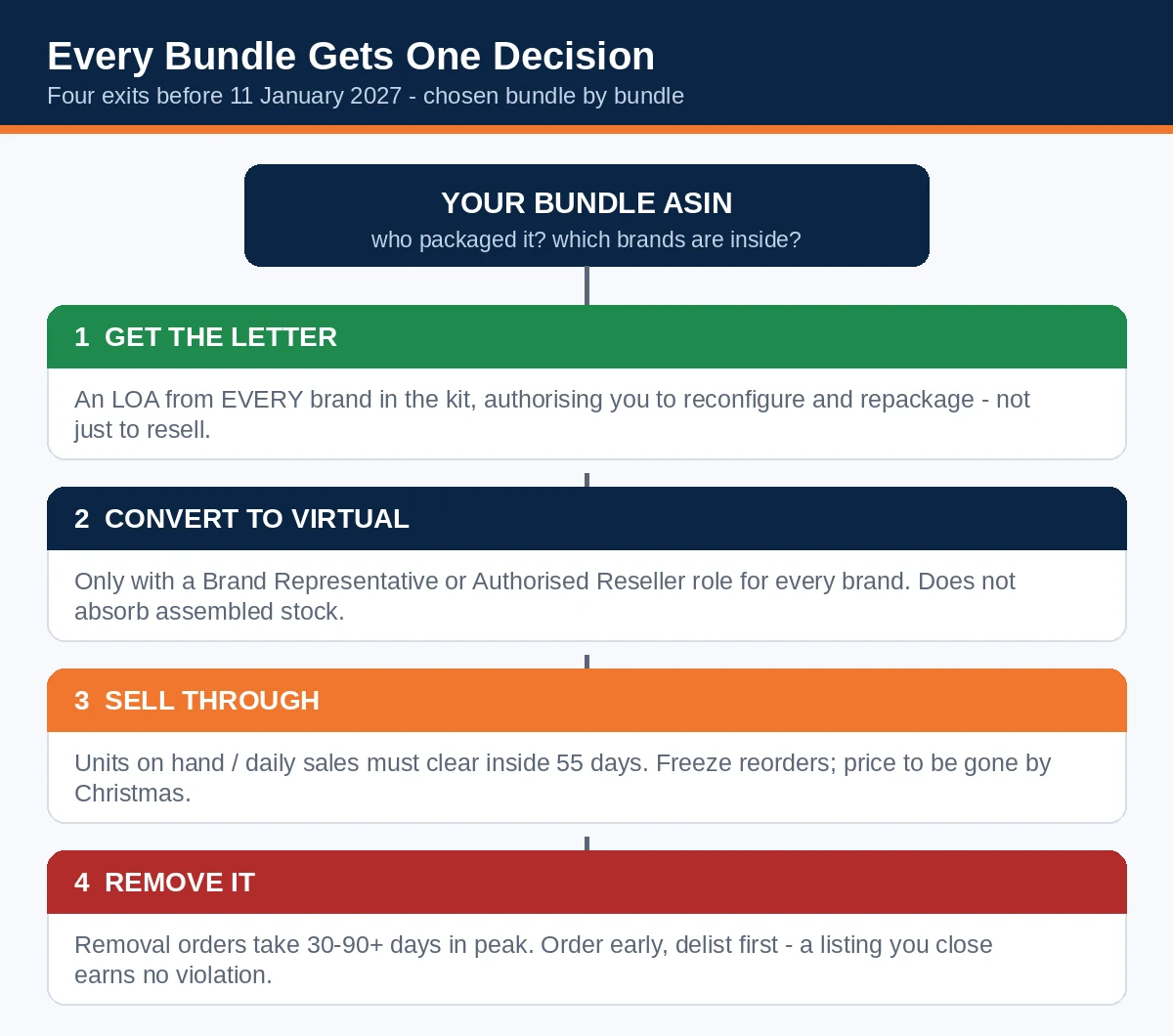
Amazon is not banning bundles. It is banning one way of making them — and it has left four doors open: a bundle can survive on a letter of authorisation from every brand inside it, it can be rebuilt as a virtual bundle, its stock can be sold through before the deadline, or it can be removed on your schedule instead of Amazon's. Every bundle you sell needs one of those four decisions, and from today, 17 November, you have 55 days to make them. This guide walks the whole job: the rule, the census, the letter, the conversion trap, the maths, and a week-by-week plan.
In 60 seconds: the exit plan on one screen
- The rule: from 11 January 2027 (US store), most single-ASIN bundles must be packaged by the original manufacturer or brand. Seller-assembled kits without authorisation are deactivated and recorded as listing violations in Account Health. Noncompliant stock may sell right up to the deadline.
- The four exits, one per bundle: (1) a letter of authorisation from every brand in the kit, granting the right to reconfigure and repackage — not just to resell; (2) convert to a virtual bundle — only if you hold a Brand Representative or Authorised Reseller role, which many resellers don't; (3) sell through before 11 January; (4) remove the stock on your own timetable.
- The exemptions: bundles in gifting browse nodes and camera product types need no manufacturer packaging. Multipacks are not bundles (a different policy covers them).
- The trap in the maths: the deadline is a date, but removal is a queue — 10–14 business days normally, 30 days or more in the holiday season, 90 days or more in peak periods. A bundle you decide to remove in January may not leave until spring.
- The trap in the conversion: a virtual bundle is a new listing built from individually stocked components. It does not absorb the assembled units already sitting in FBA — those still need a letter, a sell-through, or a removal.
- The honest caveat: the full policy text sits behind the Seller Central login, and several useful details — the letter's model wording, a claimed 30-day grace period — come from Amazon moderator replies in the announcement thread, not policy text. This guide labels every one. Plan on the policy; treat the forum as a cushion.
1. What changes on 11 January 2027 — and what Amazon hasn't said
The announcement is short. Published in the Seller Forums on 10 September 2026: effective 11 January 2027, "most product bundles listed as a single ASIN must be packaged by the original manufacturer or brand." Noncompliant inventory can still be sold before that date. After it, noncompliant bundles "will be deactivated and become listing violations on your Account Health dashboard," sellers will be notified, and FBA stock is pointed at the removal-order process.
"Packaged by" means physically packaged. Asked in the thread what the phrase means for a bundle the brand merely listed, a moderator replied on 20 October 2026 that the brand or manufacturer "must have physically packaged the bundle and not just created the listing," and that brand-packaged bundles "remain compliant and you can continue reordering." Hold that reply at arm's length: it is a dated forum answer, not a line in the policy. It is the best reading available, and this guide uses it — labelled as what it is.
This is the second round of the same rule. On 14 October 2024, Amazon limited consumables bundles — grocery, pet, baby, health and beauty — to original-manufacturer configurations; a December 2024 note added the LOA path, and enforcement on existing consumables bundles began on 1 January 2025. If you assembled consumables bundles yourself, hear this clearly: according to the same moderator, those are already prohibited under current policy — for you, January 2027 is not a deadline but a backlog. The January date brings in the "newly affected categories": everything else.
The update also opens bundling in Books, Music, Video, DVD and Video Games and allows gift cards and service plans as components — but the direction of travel is clear: bundling is moving from a seller's discretion to a documented permission.
Now the honesty paragraph. The announcement and the product bundling policy live behind the Seller Central login, and Amazon has published no public, dated policy page for this change. What the wider seller press knows comes from the announcement text as quoted by those who read it in Seller Central, plus moderator replies in the announcement thread through September and October 2026. Those replies answer real questions, but a forum reply can be revised or quietly dropped in a way policy text usually isn't. Where this guide relies on one, it says so, with the date. Before acting on any single point, check the announcement and the policy in your own Seller Central account.
2. First, sort every bundle: the census
Every exit is chosen per bundle, so the first job is a list you can trust. Pull every ASIN combining two or more different products — including ones that never use the word "bundle". The policy expects a bundle to carry the word "Bundle" in its title, a first bullet naming the items, and a main image showing all of them; a moderator warned (18 Sep 2026) that combinations not labelled as bundles "will fall under the ASIN Creation Policy," which "more generally prohibits non brand/manufacturer configurations." An unlabelled kit is no loophole — it's the same problem under a worse policy.
For each ASIN, record four things: who physically packaged it, which brands are inside and whether you own them, what letters you actually hold, and how many units sit in FBA or in transit. If a 3PL assembles for you, ask them which configurations they built. Then sort every line:
| Your bundle's situation | Status on 11 January 2027 | Your move |
|---|---|---|
| Packaged by the original manufacturer or brand | Compliant — keep reordering | Keep selling; keep proof of who packaged it |
| Every brand inside is yours | Compliant side of the policy (see the open question below) | Keep Brand Registry records as proof |
| A gift basket in a gifting browse node | Exempt | Check the basket conditions below |
| Camera or lens is the primary product | Exempt | Check the primary product type (below) |
| You hold a repackaging letter from every other brand inside | Allowed | Confirm letters cover assembly, not just resale (§3) |
| Consumables, assembled by you, no letters | Already prohibited today | Treat as urgent, not as a January item |
| Assembled by you or a 3PL, other brands, no letters | Deactivated + listing violation | Pick an exit (Sections 3–6) |
| Combines products but isn't labelled a bundle | Falls under the ASIN Creation Policy | Fix the listing, then sort it above |
| Several units of one identical product | Not a bundle — a multipack | Different policy; see below |
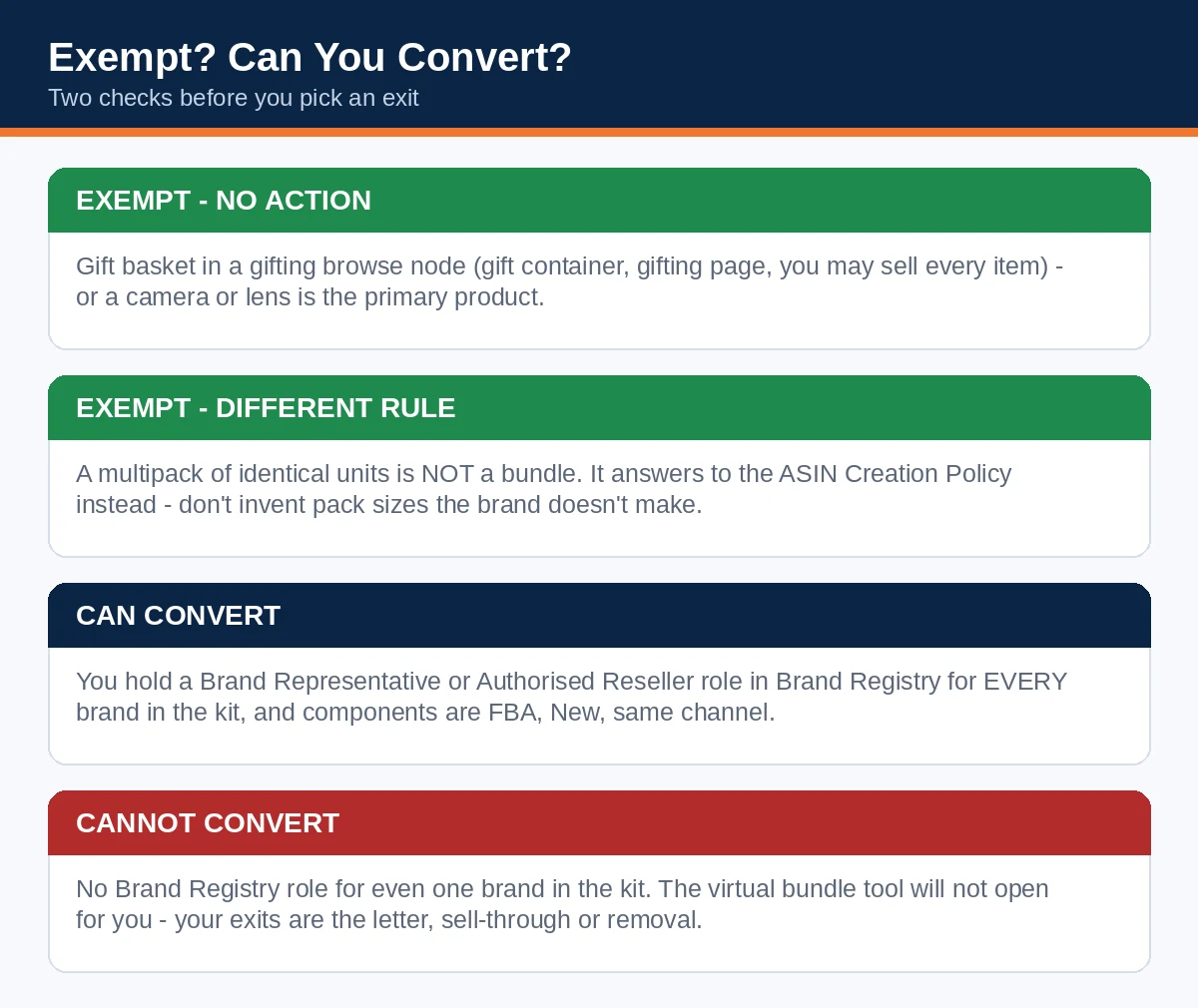
The gift basket exemption has conditions: a curated collection "physically bundled together in a single container or packaging that is designed for gifting," listed "in a gifting browse node," gifting intent clear on the detail page, and you qualified to sell every item inside it. A kit that merely could be a gift, in an ordinary node, is not exempt.
The camera exemption turns on the primary product. Bundles built around a camera or lens are exempt — but the moderator excluded BINOCULAR and CAMERA OTHER ACCESSORIES as primary types, so an accessory-led bundle doesn't inherit it. Forum-sourced: verify your product type.
Multipacks are not bundles — and not a safe harbour either. The policy states it plainly: "Bundles don't include multi-packs, which consist of two or more identical products." But multipacks fall under the ASIN Creation Policy, which says sellers "should not list non-standard multipacks that are not created by the brand owner or manufacturer" — Amazon's position since 2024 (moderator, 1 Oct 2026). The January rule doesn't touch your 3-packs; an older rule already governs them, and a pack size the brand itself doesn't make is a separate problem this deadline won't fix.
The own-brand open question. If every brand in the bundle is yours, the policy's compliant examples include bundles packaged "for brands it owns," and brand owners are plainly the intended safe side of this rule. But Amazon's pages do not address the common arrangement where a third party physically assembles a bundle for the brand, and independent coverage disagrees on how exact own-brand packaging must be. So keep Brand Registry records, packaging invoices and assembly agreements together — the answer should be a folder, not an argument.
3. Exit one: get the letter — what an LOA has to say
The letter of authorisation is the only exit that lets a seller-assembled bundle keep existing exactly as it is — and the exit most likely to fail on a technicality, because the letter Amazon wants is narrower than the paperwork most resellers already hold.
The policy asks for a letter from the brands or manufacturers of all products in the bundle — one per brand — granting "permission to reconfigure and repackage their products with all other included brands for sale as bundles in Amazon stores." Read that grant carefully: it is not permission to sell the brand's products, but to take them out of their retail packaging and rebuild them into a new product alongside other brands. The moderator's version (20 Oct): "the LOA must authorize the seller to assemble/repackage the product, not just sell it."
That distinction rules out the documents already sitting in most distributors' files. Distribution rights and reseller agreements do not count — Amazon's LOA page lists them explicitly among documents it does not accept. Brand Registry authorisation does not count either: the bundle letter is, in the moderator's words, "a more specific authorization to reconfigure a brand's products rather than sell their existing catalog."
What Amazon's LOA page does ask for is a document carrying five terms: the licensor, the licensee, the grant, the geographic scope and the term — on the rights holder's letterhead, signed by an authorised signatory, or sent as an email from the brand's own domain. Amazon "may validate your letter of authorization by contacting the relevant intellectual property owner," so a letter the brand won't stand behind is worse than none: it converts a policy problem into an authenticity problem. One quoted rejection reason: "The authorization documents provided were not authentic or current."
The same moderator published a model clause in the thread — worth building your request around, because it shows which dials the letter must set:
"[Brand owner] hereby grants [seller] the right to repackage products for [brand(s)] with [any other brand | certain set of brands] for sale as bundles on Amazon [in perpetuity | for specific term], [across all stores | for certain stores]."
Label it honestly: that clause is a forum post (20 October 2026), not policy text. The companion template with this guide is built on it — but have your own adviser review any letter before you rely on it.
Ask now, not in January. The announcement's route is reactive: the letter is uploaded to Account Health "if your bundle is identified as noncompliant after January 11" — the listing goes down first, the paperwork argument second. Either way, the brand negotiation is the slow part: requests route through legal, and some brands — large consumer brands, brands selling on Amazon themselves, brands with selective distribution — will simply decline. A request sent this week has seven weeks to survive that process. One sent in January has none.
One letter per brand — the kit is only as strong as its weakest brand. A three-brand kit needs three grants. If two sign and the third refuses, the bundle as built cannot continue — and you can't simply drop the third product, because a hard kit bundle's component items cannot be changed after creation. A different composition is a different bundle: new ASIN, new everything.
A letter restores a listing; it does not move stock or rewind time. While a flagged bundle is down, its units sit unsellable and its ranking cools. And note the quiet consequence the moderator stated plainly: once a brand permits a configuration, other sellers qualified to list that brand can offer the same bundle too. Ask for the narrowest grant that covers you ("certain set of brands," a defined term), not the widest the template allows.
The companion LOA request template with this guide is the letter to send: it names the products, quotes the grant Amazon needs to see, and asks for the five terms on letterhead. Send it this week, per brand, and log every reply in the audit worksheet.

4. Exit two: convert to a virtual bundle — and the role trap
A virtual bundle is Amazon's own answer: a listing presenting two to five existing ASINs as one offer, where each component keeps its own listing, its own FBA stock, and ships as itself. Nothing is repackaged, so the January rule doesn't reach it. For sellers who qualify it is the cleanest exit — the offer survives, the components keep their reviews and rankings, and there is no additional fee.
Here is the trap most coverage walks straight past. The bundling policy says virtual bundles "can be listed by any selling partner that is qualified to sell each individual product being bundled." The virtual bundle tool's own page closes it: the feature "is only available to sellers who have a Brand Representative or Authorized Reseller role assigned for at least one brand in Brand Registry," and components "must belong to a brand that you own or are a reseller for and that is registered in Brand Registry."
Plan by the tool's page, not the policy's looser sentence. For a typical reseller, the consequences are severe:
- No role, no conversion. A wholesale reseller who buys branded stock and sells it — never granted a Brand Registry role by those brands — cannot open the tool at all. For that seller, "convert to virtual" is not an exit; it is a description of somebody else's exit.
- Multi-brand kits need a role from every brand. Each component must belong to a brand you own or resell with a role. One brand's role converts only bundles built entirely from that brand.
- The role is the brand's to give. Like the letter, it sits on the other side of a request and a legal team's calendar. If a brand declined your letter, a role request may fare no better — though the moderator, discussing a rejected letter, suggested exactly this as the alternative ask. Make it one conversation covering both: a repackaging letter, or a Brand Registry reseller role.
If you do hold the roles, the mechanics are quick — which is why this exit is worth checking first:
- 2–5 component ASINs, each buyable on its own, each with active FBA inventory in New condition, all on the same fulfilment channel. (A single ASIN can't be bundled with itself, though a bundle can hold several units of each component.)
- You price it as a discount: the sum of the components' prices minus a percentage you set. If that lands above the components' current prices — deals included — the bundle loses Featured Offer eligibility. For the "Bundles with this item" widget it must cost at least 1% less than the parts separately, and placement still isn't guaranteed (moderator, 28 Oct 2026).
- Seller Central only — no API — and it can't join a variation family. Wrong components means delete, wait 24 hours, recreate. Components ship and return individually, so nothing assembled can be stranded.
And the limit that decides whether this exit is enough: a virtual bundle does not use, absorb or legitimise the physical units you already assembled. Finished kits in FBA are not components of anything — without a letter, they still need sell-through or removal. Conversion is an exit for the listing concept, not the inventory. Most sellers who convert will run it alongside one of the next two exits: virtual for the future, sell-through or removal for the stock that exists.
5. Exit three: sell through — do the maths before you discount
Selling through is the exit Amazon names first ("You can choose to sell any inventory that's noncompliant before January 11"), and for most bundles it will carry the bulk of the units. It is also the exit sellers most often misjudge, running it on a feeling — it's Q4, it'll move — instead of on the only calculation that matters:
Days you need = units on hand ÷ units sold per day. Days you have, from today, is 55. Count units honestly: FBA stock plus assembled units in transit plus kits your 3PL has built but not shipped. Run each bundle separately — velocity is per-ASIN, not per-catalogue. Three bundles, three velocities:
| Bundle | Units on hand | Sells per day | Days needed | Verdict by 11 Jan |
|---|---|---|---|---|
| A — flagship kit | 600 | 8 | 75 | 160 units left over — needs a second exit |
| B — mid-range kit | 220 | 5 | 44 | Clears with 11 days to spare |
| C — steady kit | 385 | 7 | exactly 55 | Clears on the last day — zero buffer |
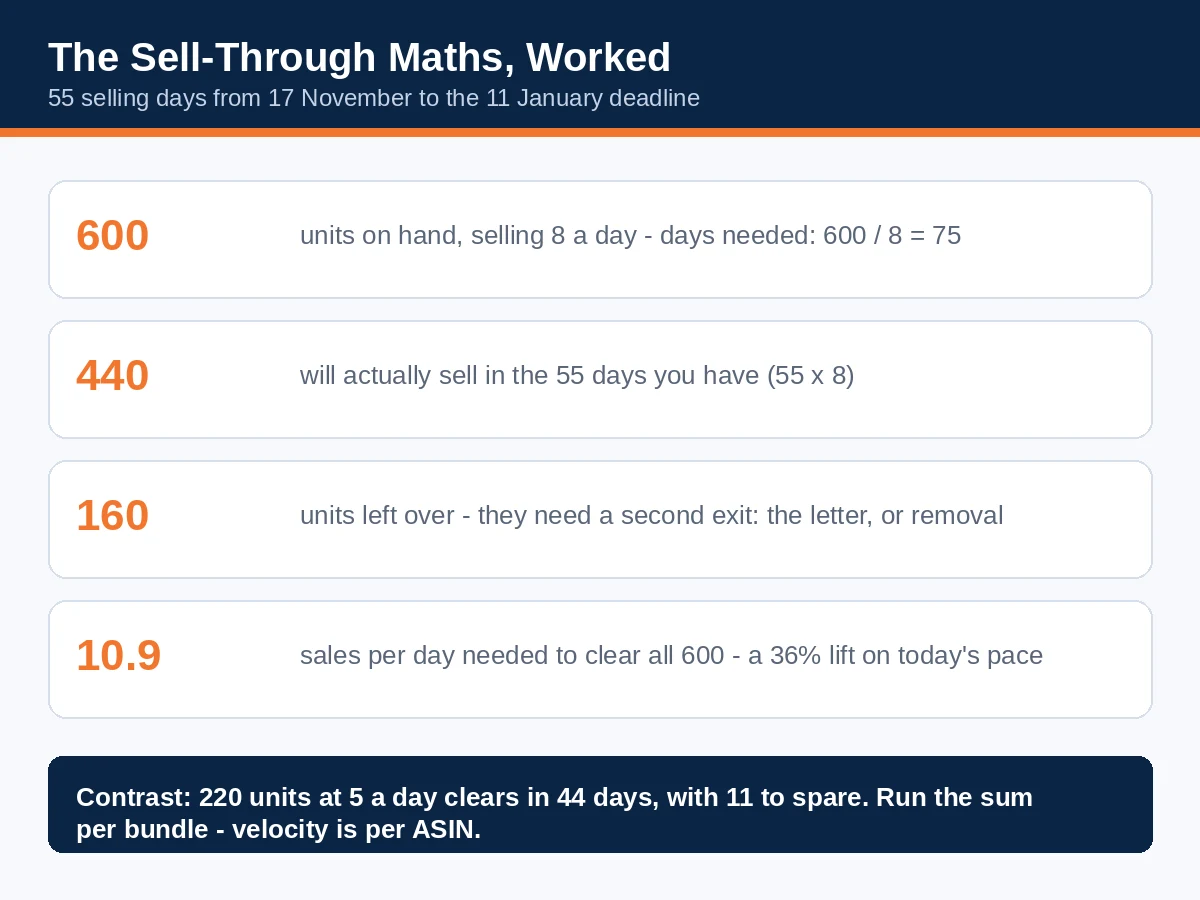
Bundle A is the one to study. At its current pace it sells 440 of its 600 units and strands 160. Clearing all 600 in 55 days needs 10.9 units a day — a 36% lift — sustained through the noisiest quarter of the year. Maybe a price cut buys that; maybe it buys 15% and strands 90 anyway. Either way, the leftover decision — discount harder in December, or place the removal order while the queue is short — is made now, from this table, not discovered on 10 January.
Treat holiday uplift as a hypothesis, not a fact. Q4 lifts most giftable products and does nothing for others — and the whole window runs on holiday peak fulfilment fees (15 Oct 2026 – 14 Jan 2027), so every unit costs more to sell. If your projection only works with an uplift you have never seen on this ASIN, it doesn't work. Run it at proven November velocity.
Freeze the reorder. Every standard reorder formula assumes the product keeps existing; none has a field for "this listing stops on a Monday in January," so the maths will cheerfully tell you to reorder components for a kit that dies on the 11th. For any bundle without a letter or an exemption: forecast demand to 10 January, subtract everything you hold, order only the gap — usually zero.
Price to be gone by Christmas, not by compliance. If the maths leaves a leftover at today's price, the discount belongs in December, while the buyers exist — not in the first week of January, when demand falls off a cliff. A unit sold at a thin margin in December is revenue; the same unit in January is a removal fee and a freight bill. And if a bundle won't clear even discounted, delist it yourself before the deadline: a listing you close generates no violation (DAM Law Firm's reading). Never leave it standing and hope.
One more wrinkle: the returns tail. Under the extended holiday returns policy, items bought between 1 November and 31 December 2026 are returnable through 31 January 2027. A kit sold on 20 December can come back on 25 January — after its listing died — and a hard kit bundle must be accepted as a single unit for returns, so it comes back as a kit: unlistable stock you will hold in February, and Amazon's pages don't say what happens to it.
6. Exit four: remove it — the removal clock is the real deadline
Removal is the exit of last resort — and the one whose deadline is not 11 January, but whenever the removal queue says it is.
Amazon's removal pages give the range plainly: a removal order "can take 10 to 14 business days to pick, pack, and process. However, removal times may increase to 90 days or more during peak removal periods." For the season you are actually in, the overview says "during the holiday season, processing may take 30 days or more" — and the carrier then takes roughly two more weeks to deliver. Orders are processed in submission order, and once one leaves Planning status, it can no longer be cancelled.
Do the arithmetic those numbers force on you. A removal ordered today might complete before Christmas or land in the new year. One ordered on 11 January — the day every unprepared seller joins the queue at once — can plausibly still be processing in April. (One mercy: no storage fees are charged on units while a removal order is processing.) Remove in November and you pay November's queue; remove in January and you pay for the delay three times — storage, queue position, and no say over timing.
The mechanics that catch people out:
- Your stock stays on sale until it leaves. Amazon's removal overview: "Fulfillable inventory is available for customers to buy until we remove it." If a bundle must stop selling, close the listing first, then remove — a removal order alone does not stop orders.
- Choose the destination deliberately. Removal can send units to an address you designate, to donation or recycling at the fulfilment centre, or to FBA Liquidations. For assembled kits, return-to-you is usually the point — but price freight and unbundling labour first.
- The receiving trap. The ship-to address locks at submission, and you agree to receive each and every unit in that order, all at once. If your recipient won't accept the full quantity in one delivery, Amazon may instruct the carrier to dispose of the units at your cost, without reimbursement. Warn your warehouse. Damage claims must be filed within 60 days of delivery.
- Fees are per unit, by shipping weight, charged as each unit leaves. Case-packed inventory comes back as individual items, not cases.
- Check your stranded-inventory settings today. A deactivated bundle leaves inventory with no live offer, and Amazon expects auto-removal preferences set for stranded stock. Decide now where yours would send the units.
Removal has a quiet second use. Components that come back are not waste: each can sell again under its own ASIN — though note the barcode rule on the way back in: from 31 March 2026, resellers must use Amazon barcodes even where a manufacturer barcode exists. The kit dies; the products inside it mostly don't.

7. Your next 55 days: the plan in order
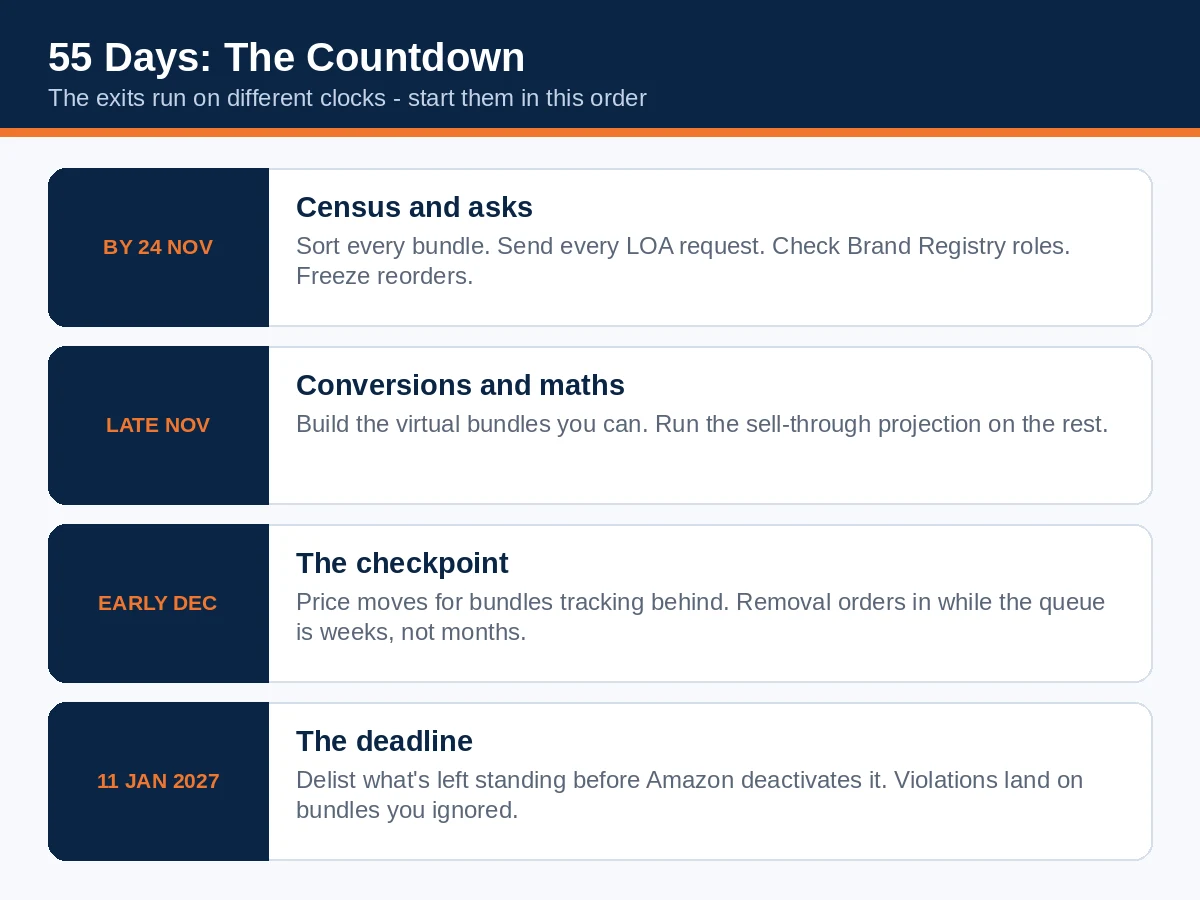
The exits run on different clocks — letters on brand legal teams, conversions on your own Seller Central session, removals on Amazon's queue — so the order you start them matters more than the order you finish them:
This week (by 24 November): the census and the asks. Build the list from Section 2 and sort every bundle. Send every LOA request the same week — the letter is the longest pole in the tent and the only exit that preserves the bundle exactly as it is. Check your Brand Registry roles in the same session; if you lack a role for a kit's brands, fold the role into the same conversation with the brand. Check your stranded-inventory auto-removal settings, and freeze reorders on every bundle with no letter and no exemption.
Late November: build the conversions, run the first maths. Create the virtual bundles for every kit you can convert. Then run the Section 5 projection on every remaining bundle at proven November velocity and write the leftover next to each one — every projected leftover gets a named second exit: harder December pricing, or removal.
Early December: the checkpoint. Compare actual sell-through against the projection. Bundles tracking behind get their price move now, while December demand can still absorb it. Place removal orders for the hopeless cases while the queue is still measured in weeks.
The week of 11 January: close what's left standing. Any bundle reaching the deadline without a letter, an exemption or a conversion should be delisted by you, before the 11th — your closure, not Amazon's deactivation, no violation attached. Confirm removal orders are in for every stranded unit, and save your letters: if a bundle is flagged despite your paperwork, the upload route is Account Health.
After 11 January: the tail. Handle the December returns arriving through 31 January as the single units they are. If the moderator-mentioned grace period materialises, use it as a cushion, not a plan. And rebuild deliberately: manufacturer-packaged, letter-authorised, virtual, exempt — the only four shapes a bundle can take now. Every future kit starts as one of them, paperwork first.
Frequently asked questions
Is my multipack affected by the January rule?
Not by this rule — multipacks are expressly not bundles. But they fall under the ASIN Creation Policy: don't list non-standard pack sizes the brand itself didn't create.
My supplier ships the products already bundled. Am I compliant?
Yes, if it genuinely arrived packaged as a unit from the original manufacturer or brand. Keep the evidence: invoices showing the products were bought as a bundled unit, and the brand packaging itself. A prep centre assembling to order is seller assembly, not manufacturer packaging.
I only bundle my own brand's products. Do I need to do anything?
Mostly no — brand owners bundling their own brands sit on the compliant side, and no letter is needed from yourself. Keep Brand Registry records as proof of ownership. The one grey area is physical assembly by a third party on your behalf: Amazon's pages don't address it, so keep the assembly agreement and packaging invoices documented.
Can I submit my letter of authorisation before 11 January?
Amazon's announcement describes the upload as happening through Account Health if a bundle is flagged after 11 January — a reactive route. A moderator added (1 Oct 2026) that sellers with a Customer Success Manager can have the CSM submit it in advance; that's forum-sourced, so don't count on it. What you can do now is the part that takes time: get the signed letter in hand.
Is there a grace period after 11 January?
A moderator wrote on 1 October 2026 that non-consumables get "an additional 30 day grace period after notification before enforcement," displayed as "Listing at risk of removal." Treat that as what it is — a dated forum reply, not policy text. Plan as if 11 January is the date; let any grace be a cushion.
The brand refused — or just never replied. What now?
Then that bundle has three exits left: convert it if you hold (or can still get) the Brand Registry role, sell the stock through by 10 January, remove whatever won't sell. Silence is an answer with a deadline attached — no response by mid-December means plan as if the answer is no.
What happens to my FBA stock on 11 January if I do nothing?
The listing is deactivated and a listing violation lands in Account Health — one per bundle, so neglected kits become a stack of violations in a single day. The stock stays in the fulfilment centre, unsellable, accruing storage, until you place a removal order and join the peak queue. Doing nothing isn't free; it invoices you later, in a worse order.
Over to you
If you do one thing today, make it the census: one sitting, every bundle ASIN, four facts per line. Most sellers find the problem smaller than the headline — a handful of kits, not a catalogue — but which handful, and how many units stand behind each one, is the whole game. The sellers this deadline hurts won't be the ones with the worst bundles, but the ones who treated an inventory problem as a listing problem and discovered in January that letters take weeks and removals take months. You have 55 days, four exits, and a worksheet. That's enough — if it starts this week.
Read next
- Amazon Virtual Multipacks: The Post-Launch Audit — Keep, Reprice or Delete the Listings Amazon Made for You (2027 Guide) — the other bundling programme sellers confuse with this one: the packs Amazon built for brand owners, and how to audit, reprice or delete them.
- Amazon Prepaid Return Labels from 18 December 2026: The 7-Day Rule, and Whether the Label Is Worth Sending (2027 Guide) — the other deadline in this same window: seven days to upload a prepaid label, or the refund comes out of your balance.
Bundles are one listing-policy deadline. The title rule was another.
Since 27 July 2026, Amazon caps titles at 75 characters and rewrites the ones that run over. The rewrite guide walks the audit, the title formula and the new Item Highlights field - with worked examples.