How to Get Reviews on Amazon in 2027
The Complete TOS-Safe Playbook
A seller's guide to earning more reviews using only the methods Amazon itself permits — updated October 2026 with the rules, fees and programmes in force heading into 2027.

Why reviews still decide everything
On Amazon, reviews are not decoration — they are the conversion engine. Research from Northwestern University's Spiegel Research Center found that a product with just five reviews is 270% more likely to be purchased than an identical product with none, and that the benefit of a high rating peaks around 4.0–4.7 stars rather than at a suspicious-looking perfect 5.0.
The problem is arithmetic. Only about 1–3% of buyers leave a review unprompted, so a new product selling 300 units a month earns perhaps three to six organic reviews in that month. Sellers who wait for reviews to "just happen" wait a long time. Sellers who try to shortcut the wait run into the toughest enforcement environment Amazon has ever operated: Amazon blocked more than 275 million suspected fake reviews in 2024 alone, and in 2025 it won court orders transferring more than 75 fake-review broker websites to itself, filed joint lawsuits with the Better Business Bureau, and brought its first joint civil action in Europe alongside Tripadvisor.
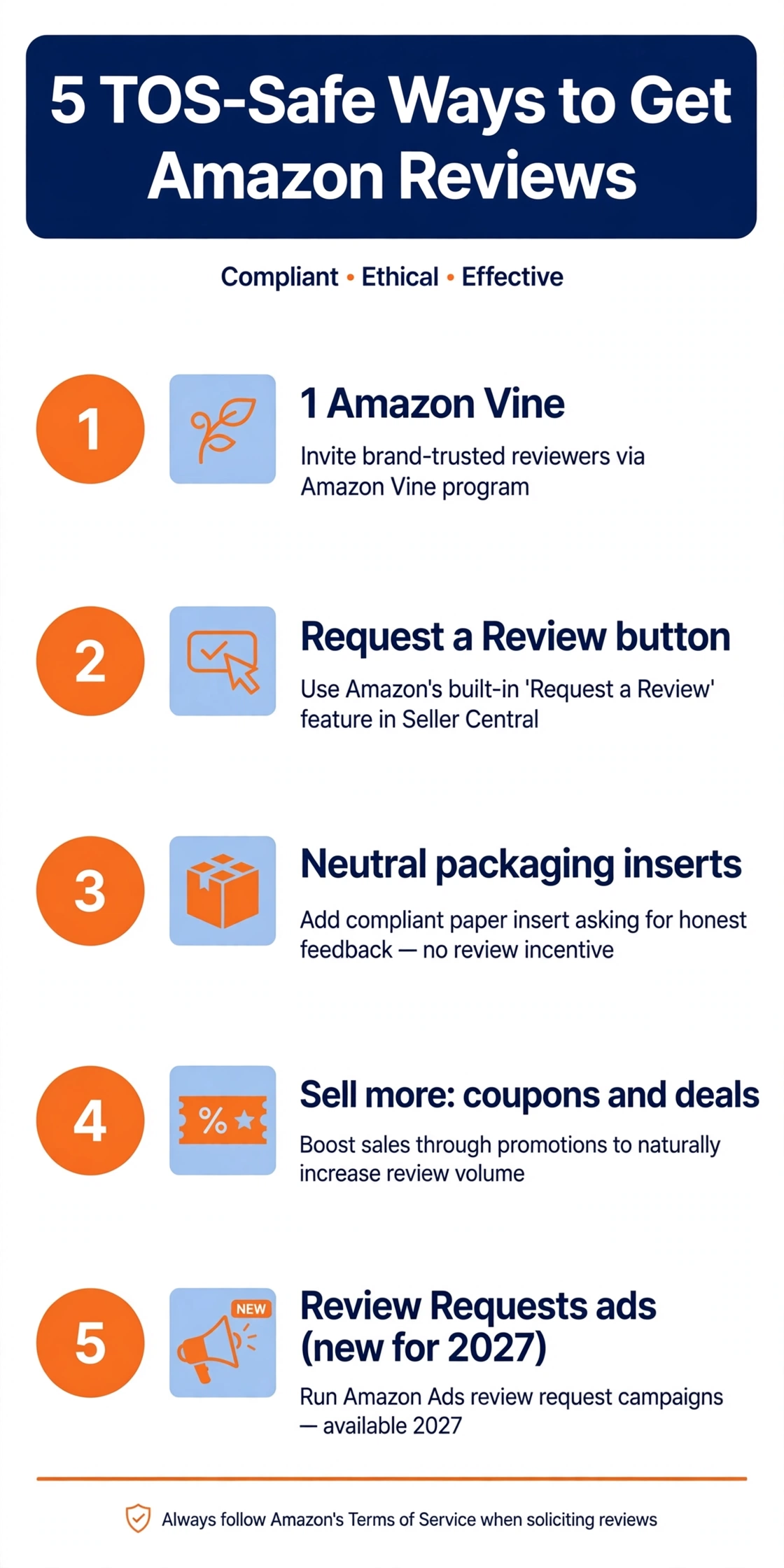
The good news: Amazon does not want sellers to stop asking for reviews. It wants them to ask in the specific ways Amazon controls. There are four proven, fully compliant review engines — Amazon Vine, the Request a Review button, neutral packaging inserts, and simply selling more units through legitimate promotion — plus a fifth, brand-new paid option arriving for 2027. This playbook covers each one, the exact rules around them, what they cost, and the order to deploy them in.
First, the rules: what Amazon bans, and what it costs you
Amazon's Anti-Manipulation Policy states the umbrella rule plainly:
"Any attempt to manipulate reviews, including by directly or indirectly contributing false, misleading or inauthentic content, is strictly prohibited."
Its Seller Central policy then spells out the specific violations. Every seller should know this list, because "seller" in the policy includes your employees and any third-party company you hire — you are liable for what an agency or broker does on your behalf, whether you knew or not.
- Posting a review of your own product, or of a competitor's product.
- Offering a financial reward, discount, free product or any other compensation in exchange for a review — expressly including review-selling services, websites and social-media review groups.
- Offering a refund or reimbursement tied to a review, and then asking the buyer to change or remove that review.
- Using a third-party service that offers free or discounted products tied to reviews, such as a review club that asks customers to register their Amazon profile.
- Reviews posted by a family member or employee of the seller.
- Asking a reviewer to change or remove their review, or offering compensation for doing so.
- Review gating: diverting negative reviews to yourself or a private feedback channel while sending positive reviews to Amazon. Asking only happy customers — or asking only for positive or 5-star reviews — is the same violation.
- Creating variation relationships between products to pool or inherit reviews ("variation hijacking" / catalogue abuse).
- Inserting a request for a positive review, or an incentive for a review, into product packaging or a shipping box.
- Using a customer account to write or change a review on your own or a competitor's product.
The penalties are deliberately severe, and Amazon describes them as zero tolerance: immediate and permanent withdrawal of selling privileges with funds withheld; removal of all of the product's reviews and a block on it receiving future reviews; permanent delisting; legal action and referral to law enforcement; and public disclosure of the seller's name. In short, one shortcut can end the business, not just the listing.
It is not just Amazon anymore: the law has caught up
Since 21 October 2024, fake and bought reviews are also a legal liability in the United States. The FTC's Rule on the Use of Consumer Reviews and Testimonials (16 CFR Part 465) bans creating, buying or selling fake reviews — expressly including AI-generated ones and reviews from people who never used the product; it bans paying for reviews conditioned on a particular sentiment, whether positive or negative; it bans undisclosed insider reviews by employees and their relatives; it bans review sites a company secretly controls posing as independent; it bans suppressing negative reviews through threats or intimidation; and it bans fake social-media influence indicators. Each violation can carry a civil penalty of up to $53,088 (the 2025-adjusted figure, unchanged for 2026) — and each individual fake review can count as a separate violation. The FTC sent its first warning letters under the rule to ten companies in December 2025.
In the UK, fake reviews and concealed incentivised reviews became banned practices under the Digital Markets, Competition and Consumers Act from 6 April 2025, with the CMA able to fine up to 10% of global turnover. In June 2025 Amazon gave the CMA formal undertakings to strengthen its detection of fake reviews and catalogue abuse.
Practical takeaway: in 2027, "everyone does it" is not a defence, "my agency did it" is not a defence, and the downside is no longer just a suppressed listing — it is account termination, withheld funds, lawsuits and regulatory fines.
Play 1: Amazon Vine — the only sanctioned free-product-for-review programme
Amazon Vine is the foundation of almost every compliant launch strategy. Brand-registered sellers give Amazon free units from their FBA inventory; Amazon offers them to its invitation-only panel of trusted reviewers, the Vine Voices, who publish honest reviews badged "Vine Customer Review of Free Product." The badge matters: Vine is the single exception to Amazon's ban on free products in exchange for reviews, because Amazon — not the seller — controls the reviewers. You cannot choose, contact or influence them, and you cannot remove an unfavourable Vine review unless it violates policy.
Eligibility
- Professional selling plan.
- A Brand Representative or Reseller role for a brand enrolled in Amazon Brand Registry (eligible generic products can also qualify).
- An FBA offer in "New" condition with an image and description on the detail page.
- Fewer than 30 reviews already on the listing.
- Excluded: adult, digital and bundled products, and a small number of category-specific exceptions.
Fees (per parent ASIN, tiered by units enrolled)
| Units enrolled | US fee | UK fee |
|---|---|---|
| 1–2 | $0 | £0 |
| 3–10 | $75 | £60 |
| 11–30 | $200 | £140 |
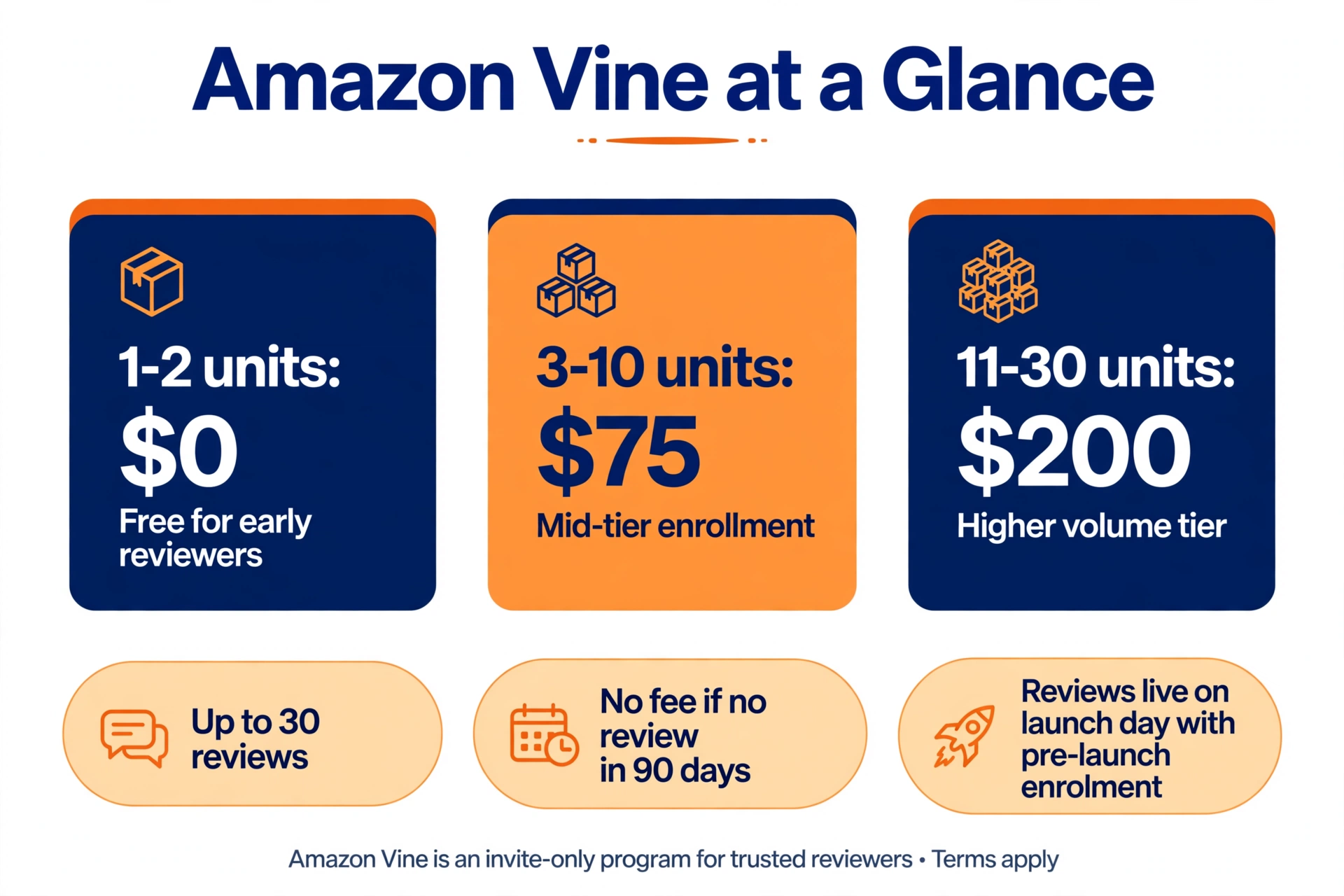
There is no enrolment fee for child ASINs under the same parent. Two protections make Vine low-risk to test: if no Vine review is received within 90 days of enrolment, no fee is charged at all. (Sources disagree on the exact billing date when a review does arrive — most guides say seven days after the first review publishes; check the terms shown in your own enrolment confirmation in Seller Central.) New brands also receive a $200 Vine credit under New Seller Incentives — enough to cover one full 30-unit enrolment.
The pre-launch upgrade (2025)
Since mid-2025 you can enrol a product before it launches: set a future launch date, get inventory into FBA at least three weeks ahead, and Vine Voices can order and review while the reviews stay hidden. On launch day they publish automatically — day-one social proof instead of the usual cold start. One practical warning: some sellers in Amazon's own forums reported early pre-launch enrolments sitting at "awaiting inventory" until the offer was activated, so enrol early and verify the status rather than discovering the problem in launch week.
What Vine really costs, and what you get
The fee is the small part. You also give away the units: product cost plus FBA fulfilment fees on every enrolled unit. A realistic full enrolment — 30 units at $12 product cost and $5 FBA fee, plus the $200 fee — totals about $710. Enrolment does not guarantee 30 reviews: units must be claimed, and not every claimed unit converts. Seller experience puts completion at roughly 60–90%, i.e. about 18–27 reviews from a full enrolment, landing at roughly $19–$39 per realised review. Amazon staff guidance puts the timing at about 25% of a Voice's reviews arriving within five days of their order and 99% within 35 days — in practice, the bulk lands in two to four weeks. For the launch value of opening with 20-odd genuine reviews, most brands consider that the best money in this entire playbook.
Play 2: Request a Review — the free button you should press on every order
Inside Seller Central, every order's detail page has a "Request a Review" button. One click sends a single, standardised email written by Amazon asking the buyer for both a product review and seller feedback, auto-translated into the buyer's language. Because Amazon writes the words, the request is compliant by definition — there is nothing to wordsmith and nothing to get wrong.
- Window: usable once per order, between 5 and 30 days after delivery. (Older guides citing "4–30 days after purchase" are outdated.)
- Once only: if the buyer has already reviewed, or has opted out of messages, the request will not go. Amazon also solicits reviews from buyers on your behalf automatically — extra seller requests on the same order are treated as unnecessary.
- Timing within the window: ask after the buyer has genuinely used the product — roughly 5–7 days for consumables, 7–14 days for most physical goods, 14–21 days for complex durables such as electronics, tools and furniture.
Automating it — allowed, with one bright line
You may automate the button, and at any real order volume you should. The safe tools — Helium 10 Follow-Up, Jungle Scout Review Automation, FeedbackFive and similar — work by triggering Amazon's official request through Amazon's API or Appstore templates. The bright line: a tool that composes and sends its own custom review email is not using the button's safe harbour, and that is where most messaging violations come from. Whatever you use, enforce three rules: once per order, inside the 5–30 day window, and no duplicate ask through Buyer-Seller Messaging on the same order.
Does it work? An honest answer
Every credible 2026 guide recommends using Request a Review on 100% of eligible orders, but be clear-eyed about the evidence: there is no rigorous independent study of its lift, and the eye-catching statistics repeated in blog posts could not be traced to a primary source, so this playbook does not quote them. Vendor claims for systematic requesting cluster around review rates of roughly 2–5%, against a 1–3% unprompted baseline — plausible, unaudited, and category-dependent. The cost-benefit case does not depend on the exact number: the button is free, takes seconds (or zero ongoing effort once automated), and a missed 30-day window is a permanently lost ask.
Play 3: Packaging inserts — the neutral ask, in Amazon's own words
Amazon expressly allows a card in your packaging that solicits reviews "in a neutral manner." Done right, an insert reaches every buyer at the exact moment of unboxing, including buyers who ignore email. Done wrong, it is the single most common insert-related violation — Amazon treats a positive-review ask on a card exactly as it treats one in a message.
Amazon's own examples
| ✅ Compliant | ❌ Non-compliant |
|---|---|
| "Thank you for your purchase! Feel free to share your honest feedback by leaving a review." | "If you are satisfied, leave us a 5-star product review" — printed with a gift-card offer. |
| "We are a small family business so that your product review would mean the world to us." | "We would be very pleased if you leave us a positive review" — printed with five yellow stars. |
| — | "If you are happy, please leave a positive review! If anything makes you dissatisfied, contact our customer support team" — followed by an email address. This is gating plus off-Amazon diversion in one card. |
| — | "Scan here to qualify for your warranty" — a QR code leading to a page that requires a review. Warranty access must never be gated on a review. |
Drafting rules that keep an insert safe
- Ask for honest feedback, never for positive, 5-star or "if you loved it" feedback. Do not print star imagery that implies the rating you want.
- Offer nothing in exchange — no discount code, gift, prize entry, extended warranty or free product tied to reviewing, even if the offer is printed for everyone. If it reads as the reward for the review, it is an incentive.
- Keep support and the review ask separate and unconditional. Setup help, care instructions and warranty information are fine for every buyer. What is banned is the two-path card — "Love it? Review us! Problems? Contact us!" — which routes unhappy buyers away from Amazon. That pattern is the number one insert audit failure.
- No personal contact details and no off-Amazon links for review solicitation or customer service. QR codes are not banned in themselves (a setup video is fine), but a QR journey that gates content on a review, captures the buyer off-Amazon for review asks, or diverts service off Amazon is a violation — Amazon judges the whole journey the code starts.
The consequences of getting this wrong are not theoretical: flagged inserts have triggered Account Health "at risk of deactivation" notices for review manipulation, ASINs marked unsellable with FBA inventory blocked, and appeals demanding the exact insert text, every ASIN it shipped with, and a corrective plan of action.
Play 4: Buyer-Seller Messaging — service channel first, review channel last
Buyer-Seller Messaging exists to complete orders and serve customers, not to market. Amazon divides seller-initiated contact into necessary messages (needed to fulfil the order) and Proactive Permitted Messages — which must be sent within 30 days of order completion, include the 17-digit order ID, and be in the buyer's preferred language. The permitted list does include one neutral request for a product review or seller feedback per order.
Here is the honest state of play in 2026. On paper, Amazon's Communication Guidelines still allow that single neutral BSM request. In practice, several current compliance sources argue the channel has effectively closed for review asks and that the Request a Review button is now the only solicitation Amazon wants sellers to use — and that using both channels on the same order can itself draw a restriction. The risk-minimal consensus, and this playbook's recommendation: make Request a Review your only review ask, and reserve Buyer-Seller Messaging for service. If you do use a BSM review request, it is once per order, neutrally worded, with no incentive, no "positive experience only" condition, and never on an order where the button was already used.
- Never in any message: order or shipping confirmations (Amazon sends them), thank-you-only messages, marketing, coupons or cross-sells, incentives of any kind, requests to remove or change a review, or external links unless they are secure and genuinely necessary to complete the order.
- Penalties scale: a blocked message and warning, then a 30-day restriction on proactive messaging for repeat violations, then suspension for serious cases such as off-platform redirects or manipulation.
- Respond to buyer messages within 24 hours, including weekends — it is a service-level requirement, and late responses damage Account Health. (Request a Review emails come from a no-reply Amazon address and do not count against your response time.)
- Never contact buyers outside Amazon about an order or a review. Order communication must stay in Amazon's anonymised relay; harvesting details from an order or insert to email or phone a buyer about a review is both a data-use and a manipulation violation.
Handling a negative review — compliantly
You may contact an unhappy buyer through Buyer-Seller Messaging or the Brand Registry Customer Reviews tool to offer a refund or replacement and genuinely fix the problem. What you may not do is mention changing or removing the review, or condition the resolution on it. Fix the root cause, and report reviews that themselves break policy (abuse, personal data, seller-feedback content sitting in a product review). That is the whole of the compliant playbook for negatives.
Play 5: Sell more units — volume is the long-run review engine
Every compliant review tactic above multiplies a number you already have: buyers. At a 1–3% natural review rate, the only way to more reviews in the long run is more orders. Amazon not only allows price promotion for this — it says it "welcomes and encourages" coupons, discounts and deals to lower prices and drive incremental sales. The line is simple: a discount may reward a purchase, never a review, and must be open to everyone on the same terms.
- Coupons: the badge in search results lifts click-through. Launch guidance from seller practice is a 10–20% coupon for the first four to six weeks; you pay the discount plus a small per-redemption fee (commonly around $0.45–$0.60 in the US — check your marketplace in Seller Central). Beware discount stacking: a coupon, a Prime Exclusive Discount and business pricing can accidentally combine toward near-free.
- Prime Exclusive Discounts: Prime-only strikethrough pricing with Deals-page exposure during Prime events.
- Lightning Deals and 7-Day Deals: the highest-visibility velocity Amazon sells — but eligibility normally requires a sales and rating track record, so sequence them after Vine has seeded your first reviews, not on day one.
- External traffic, done legally: drive your social, email and web audience to your listing or Brand Store for sales, using a plain link or an Amazon Attribution tag. Brand Registry sellers earn the Brand Referral Bonus — an average of about 10% of the attributed sale price, credited against referral fees (not paid as cash), on a 14-day attribution window, paid roughly two months later once returns settle. Category rates vary widely (roughly 5% in Electronics up to 30% for Amazon Device Accessories, per seller guides).
And the banned mirror image: "two-step URLs," "super URLs," funnels, treasure hunts and search-find-buy schemes — anything designed to make a buyer search a keyword and buy so the sale looks organic — are an explicit violation of the Seller Code of Conduct, and Amazon has reminded sellers since November 2021 that they are responsible for third-party services doing this for them. Likewise, asking your followers or email list to "go leave a review" is not a compliant tactic: if they have not genuinely bought the product, or were screened for satisfaction, or were offered anything, it breaches the rules in the rules section. Promote the product; let real buyers decide about reviewing, through Amazon's own prompts.
What is new for 2027
1. Amazon Ads "Review Requests" — Amazon now sells the ask itself
Announced at unBoxed on 29 September 2026 and entering open beta in the US in late October 2026, Review Requests is an Amazon Ads campaign type that shows a native prompt to people who recently bought your product while they browse Amazon's highest-traffic pages; one tap submits a star rating, with an optional written review or photo. Key facts: your product must have fewer than 1,000 total ratings and reviews, and campaigns pause automatically at 1,000; your ad account must be in good standing; US only at launch. Amazon reports that in a closed beta (3–21 June 2026) products received three times as many ratings and reviews per week as before the test — note that this is Amazon's own before-and-after figure over 19 days, with no disclosed control group, so treat it as promising rather than proven. Amazon has not published the pricing or exactly what event you pay for; third-party reports suggest a click-based model. Test it with a pre-set maximum cost per additional rating, and measure your own weekly baseline first so you can judge the lift on your data, not Amazon's.
2. Variation reviews no longer pool the way they used to
Between 12 February and 31 May 2026, Amazon rolled out a restriction on review sharing across variations. Reviews are still shared between variations that differ only in minor, non-functional ways — colour or pattern, size that does not change function, pack quantity, a secondary scent, or fitment for the same product type. They no longer share where the difference affects performance or expectations: power, memory, speed or capacity; different models or generations; bundle versus standalone; flavour, ingredient or formulation; a primary scent; performance-affecting materials; different skill levels. For 2027 planning this means each functionally distinct variant increasingly stands on its own review count and needs its own Vine and review plan — and the old "merge a new product into a reviewed listing" trick is now blocked twice over: by policy and by mechanics.
3. Keep product ratings and seller feedback separate in your head
Two different systems are constantly confused in seller blogs. Product ratings have accepted one-tap star ratings (no written text) since 2019–20, and the number on a detail page combines ratings and written reviews. Seller feedback went star-only in August 2025 — text became optional, low-star feedback requires selecting a reason, and star-only feedback cannot be appealed through Feedback Manager. The August 2025 change was about seller feedback, not product reviews, whatever the headlines said.
4. AI now reads your reviews to shoppers
Since August 2023, product pages carry AI-generated review highlights — a short paragraph and clickable attribute tags summarising the themes across your written reviews — drawn only from Amazon's trusted, verified-purchase review corpus. Layered on top, Amazon's AI shopping assistant (Rufus, renamed and merged into "Alexa for Shopping" in the US in May 2026, with more than 300 million users during 2025) answers shopper questions and compares products using your reviews, your Q&A and your listing copy as one corpus. The 2027 implication: the themes of your reviews are now your headline. A recurring complaint becomes the summary every shopper reads — which is why mining reviews weekly and fixing the repeated defect is a review strategy, not just a product one. And never try to seed phrasing through fake reviews: that is manipulation under the rules, and the AI will amplify whatever is genuinely repeated anyway.
The launch playbook: the plays in order
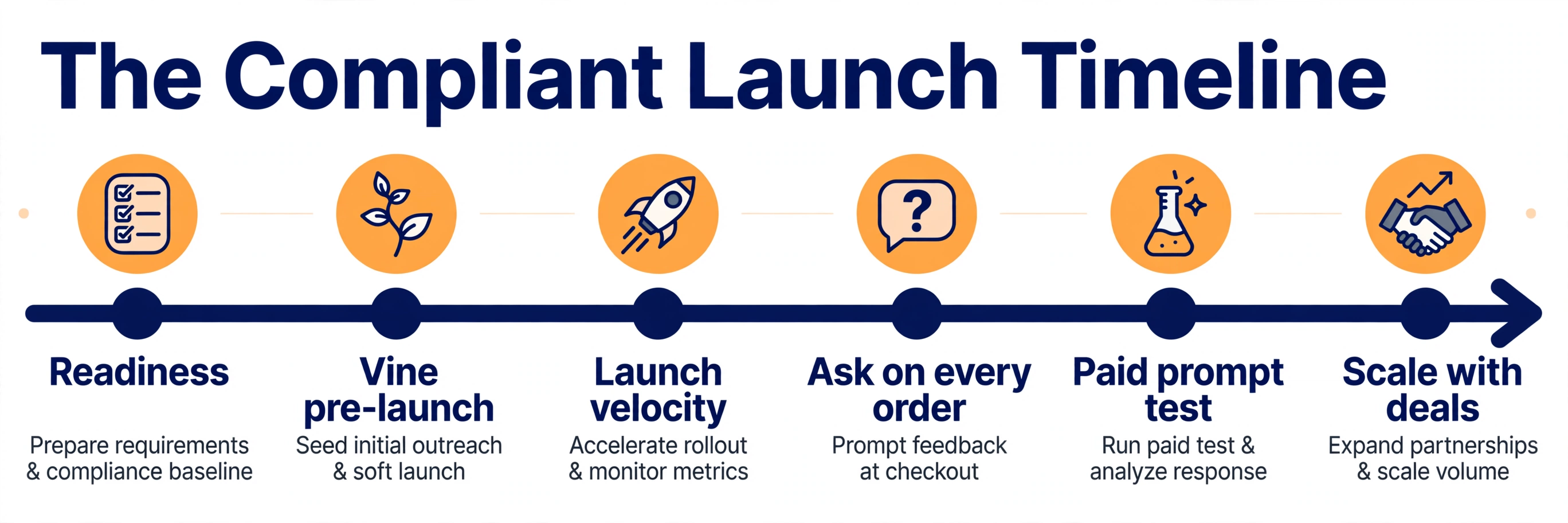
| Phase | When | What to do | Realistic outcome |
|---|---|---|---|
| 0. Readiness | Before enrolment | Finish Brand Registry. Fix the product, listing and packaging first — every accelerator below amplifies existing sentiment, good or bad. Print the neutral insert into launch stock. | A product you honestly expect to earn ~4.3 stars or better. |
| 1. Vine, pre-launch | Inventory in FBA 3+ weeks before launch | Enrol the full 30 units (or the 3–10 tier to limit exposure on an unproven product). Reviews build hidden and publish on launch day. | About 18–27 reviews around launch; cost ≈ $500–$710 all-in at typical unit economics, or a $200 new-brand credit covers the fee. |
| 2. Launch velocity | Weeks 1–6 | PPC plus a coupon open to all buyers; external traffic through Attribution links to earn the Brand Referral Bonus. No offer is ever conditioned on a review. | Sales begin converting to reviews at the natural 1–3%. |
| 3. Systematic asking | Every order, days 5–30 after delivery | Automate Request a Review on 100% of eligible orders via an official-template tool. One ask, no messaging duplicate. Read reviews weekly; resolve problems through messaging without mentioning the review. | Review rate moves from the ~1–2% unprompted baseline toward the low single digits. |
| 4. Paid prompt (new) | While under 1,000 ratings | Test Review Requests ads with a capped cost per additional rating, judged against your own baseline. | Amazon's closed-beta claim: 3x ratings/reviews per week — unverified independently; measure it yourself. |
| 5. Scale | Once a track record exists | Lightning / 7-Day Deals and Prime Exclusive Discounts around Prime events; audit variation families so each functional variant builds its own reviews. | Each velocity burst adds reviews at the natural rate on a larger buyer base. |
Set expectations with the maths, not with hope. Without Vine, a product selling 300 units a month at a 1–2% unprompted rate takes roughly four to eight months to reach 25 reviews; with Vine, a comparable count arrives in about two to four weeks. A launch month combining Vine with systematic requesting can plausibly end at 20–35 total reviews, and 50–100 reviews is a realistic three-to-six-month goal for a steadily selling product — not a launch-week promise. Ratings (one-tap stars) accumulate faster than written reviews, which helps the headline number sooner.
Dead tactics and red flags
- The Early Reviewer Program is dead. Amazon stopped enrolments on 10 March 2021 and closed it on 25 April 2021. Any agency or tool still selling "Early Reviewer" access in 2027 is selling something that does not exist; the similarly named third-party services are not Amazon programmes, and any workflow that ties a free or discounted product to an Amazon review falls foul of the compensation and review-club bans.
- Review clubs, Telegram/Facebook review groups, refund-after-review ("buy, review, we PayPal you back") and paid "product testers" are the banned conduct list verbatim — and the sellers, not just the brokers, are who Amazon terminates. Amazon deactivated more than 150 broker websites and sued operators through 2025–2026, including joint actions with the BBB and, in Europe, with Tripadvisor.
- "Contact us before leaving a review — we'll make it right," and later asking the buyer to revise their feedback, still appears in highly ranked "feedback strategy" articles. It is review diversion plus asking for a review change. Do not follow it, however polished the source looks.
- Unverifiable statistics. If a guide quotes a precise lift figure for a review tactic with no methodology behind it, treat it as marketing. This playbook has deliberately left out the most repeated such number because it could not be traced to any primary study.
- Discount codes, gifts or "warranty registration" bundled with a review ask — on an insert, in a message, or on a landing page a QR code leads to — are incentives and gating, however they are dressed up.
The one-page checklist
- ☐ Brand Registry complete; product, listing and packaging genuinely review-ready.
- ☐ Neutral insert printed: honest-feedback ask only, no stars, no incentive, no two-path routing, no off-Amazon contact.
- ☐ Vine enrolled pre-launch, full 30 units where the product justifies it; enrolment status checked, not assumed.
- ☐ Request a Review automated on every eligible order, day 5–30 after delivery, official templates only, same rule for every buyer.
- ☐ Buyer-Seller Messaging reserved for service; 24-hour responses; no second review ask, no review language in problem resolution.
- ☐ Promotions open to all and never review-conditioned; external traffic via Attribution links; Brand Referral Bonus claimed.
- ☐ No two-step URLs, search-find-buy, review clubs, brokers or "testers" — and no agency you cannot audit against the banned list.
- ☐ Reviews mined weekly; repeat complaints fixed at the source; AI review highlights checked for what shoppers are being told.
- ☐ Under 1,000 ratings? Budget a capped test of Review Requests ads against your own baseline.
- ☐ Every functionally distinct variation has its own review plan — pooling is over.
The bottom line
Getting reviews on Amazon in 2027 is not a mystery and it is not a hack. Amazon has built — and now, with Review Requests, even sells — a complete set of sanctioned ways to ask: Vine for the launch, the Request a Review button on every order, a neutral insert in every box, promotions and external traffic to grow the buyer base the percentages apply to, and messaging kept clean for service. The sellers who win are the ones who run all of them, on every order, for months — while competitors keep renting shortcuts that now end accounts, freeze funds and attract regulators. Play the long game Amazon has actually laid out, and the reviews compound.
Want to grow your Amazon business with a compliant review strategy?
Explore our approach to product testing and sustainable Amazon seller growth.