Amazon Vine for Sellers
Cost, Eligibility, and Whether It’s Worth It
Vine is Amazon’s own launch accelerator: up to 30 honest reviews before your listing has meaningful sales — for a fee, your free units, and no control over what reviewers say. This guide runs the real cost per review at three price points, the break-even test that decides whether it’s worth it, and the mistakes that waste an enrolment. Updated November 2026.

Introduction
A note on who this guide is for, because the search results never make the distinction: this is the seller guide to Amazon Vine — for brand owners deciding whether to enrol a product and pay for it. If you are a shopper hoping to be invited as a Vine Voice and receive free products, this article will not help you; Amazon invites reviewers itself, there is no application, and anyone charging you a fee to "get into Vine" is running a scam. Sellers: read on.
Every product launch on Amazon starts with the same trap. A listing with no reviews converts badly. A listing that doesn't convert gets few sales. Few sales means few reviews. Vine is Amazon's official way out of that trap: you give up to 30 units of a new product, free, to a pool of reviewers Amazon has invited and vetted — the Vine Voices — and they publish honest reviews, badged as a "Vine Customer Review of Free Product", before or just after your launch. It is the only programme on Amazon where giving products away for reviews is not just tolerated but run by Amazon itself.
It is also routinely misunderstood. Sellers enrol products that aren't ready and collect detailed, credible, negative reviews at the exact moment their listing can least afford them. Sellers budget the $200 enrolment fee and forget the free inventory costs more than the fee. Sellers enrol one cheap variation expecting the reviews to bless the whole family — a tactic the 2026 variation split has now ended. And sellers ask the only question that matters — is it worth it? — without ever running the arithmetic that answers it.
This guide runs it. Eligibility first, then how enrolment actually works, the true cost (fee, free units, fulfilment — with worked cost-per-review numbers at three price points), how many reviews you realistically get, what the 2026 variation split changed, a break-even framework for the worth-it decision, the mistakes that waste an enrolment, a launch sequence, and an FAQ. It builds on our reviews playbook, which covers Vine briefly among all the review channels; this is the deep dive on Vine alone.
In 60 seconds: Vine on one screen
- What it is: Amazon's own review programme. Brand-registered sellers enrol a product, offer up to 30 free units to invited reviewers (Vine Voices), and receive honest reviews carrying a Vine badge. You choose the product and the unit count — never the reviewers, the ratings or the words.
- Who can use it: Professional-plan sellers with a Brand Representative or Reseller role on a brand in Brand Registry (eligible generic products can also qualify). The product must be an FBA offer in New condition with fewer than 30 reviews, an image and a description. Adult, digital and bundled products are excluded.
- What it costs: an enrolment fee per parent ASIN — $0 for 1–2 units, $75 for 3–10, $200 for 11–30 — charged only after your first Vine review publishes, and not charged at all if no review arrives within 90 days. The free units themselves usually cost more than the fee.
- What you get: up to 30 reviews is a cap, not a promise. Units must be claimed and then reviewed; seller experience on a full enrolment commonly lands around 18–27 reviews.
- The 2026 change that matters: reviews no longer pool across functionally different variations, so enrolling one cheap variation no longer seeds the whole family.
- The verdict: Vine is worth it when your product is genuinely ready, your price point can absorb roughly $20–$50 per review, and reviews are the bottleneck. It is a waste — or worse — when the product or the listing still has fixable flaws.
1. What Vine is, and what it is not
Amazon invites Vine Voices itself, from shoppers with a track record of writing reviews other customers find helpful. Voices browse a catalogue of enrolled products, request what interests them, receive it free through normal FBA delivery, and publish a review. Three design choices define the programme, and every seller frustration with Vine traces back to one of them:

Amazon controls the reviewers; you control nothing after enrolment. You cannot select Voices, see who claimed your product (Vine orders appear in your reports at $0, with no customer identity), contact them, or respond to the programme in any way except by reading the reviews. Reviewer anonymity is protected structurally: every Vine unit ships through FBA precisely so your systems never learn who received it.
The reviews are honest by design — including honestly negative. A Vine review carries the same weight in your star rating as an organic review, and Voices are known for thorough, detailed assessments. That credibility is exactly why shoppers trust the badge, and exactly why enrolling a flawed product backfires: a detailed 2-star Vine review on launch day is worse than no review, because it is believable.
Vine is a launch tool, not a growth tool. The fewer-than-30-reviews eligibility ceiling means Vine exists to cold-start listings. A product that already sells and reviews organically has largely outgrown it — which is why the timing in Section 8 matters as much as the decision itself.
What Vine is not: it is not a review service, not advertising (it sits in the Advertising menu, but no placement is bought), and not a guarantee. And it is not available to everyone — which brings us to the gates.
2. Eligibility: two checklists, both pass/fail
Eligibility has a seller level and a product level, and failing any single item ends the conversation. Amazon's Vine dashboard in Seller Central is the final authority for your specific ASINs, but the published rules are these:
Your account must have:
- A Professional selling plan ($39.99/month). Individual-plan sellers cannot enrol.
- For a branded product, a Brand Representative or Reseller role on a brand enrolled in Amazon Brand Registry. (If your trademark is still pending, Brand Registry has a path for pending trademarks; enrolment in Registry is the long pole for most new brands, so start it before you need Vine.)
- Eligible generic (unbranded) products in your catalogue can also qualify without a brand — the dashboard will show them if so.
The product must have:
- An FBA offer in New condition, with inventory available at Amazon. FBM-only products cannot enrol — the anonymity design requires Amazon to fulfil the units.
- Fewer than 30 reviews on the product detail page. At 30, the door closes.
- At least one image and a product description on the listing.
- A category Amazon allows: adult products, digital products and bundled products are excluded outright.
Enrolment is set per parent ASIN, and child variations ride along at no extra fee — enrol the parent, choose how many units, and the variations under it are the offer. That sentence carried a large tactic until this year; Section 6 explains what changed.
One enrolment-hygiene rule before the steps: treat enrolment as a considered, one-shot decision per product. You can cancel an enrolment only while no unit has been claimed; once claims begin, you can stop further claims but you cannot reverse the enrolment, and claimed units can still produce reviews. Decide the unit count deliberately (Section 7), because improvising later is not really available.
3. How enrolment works, step by step
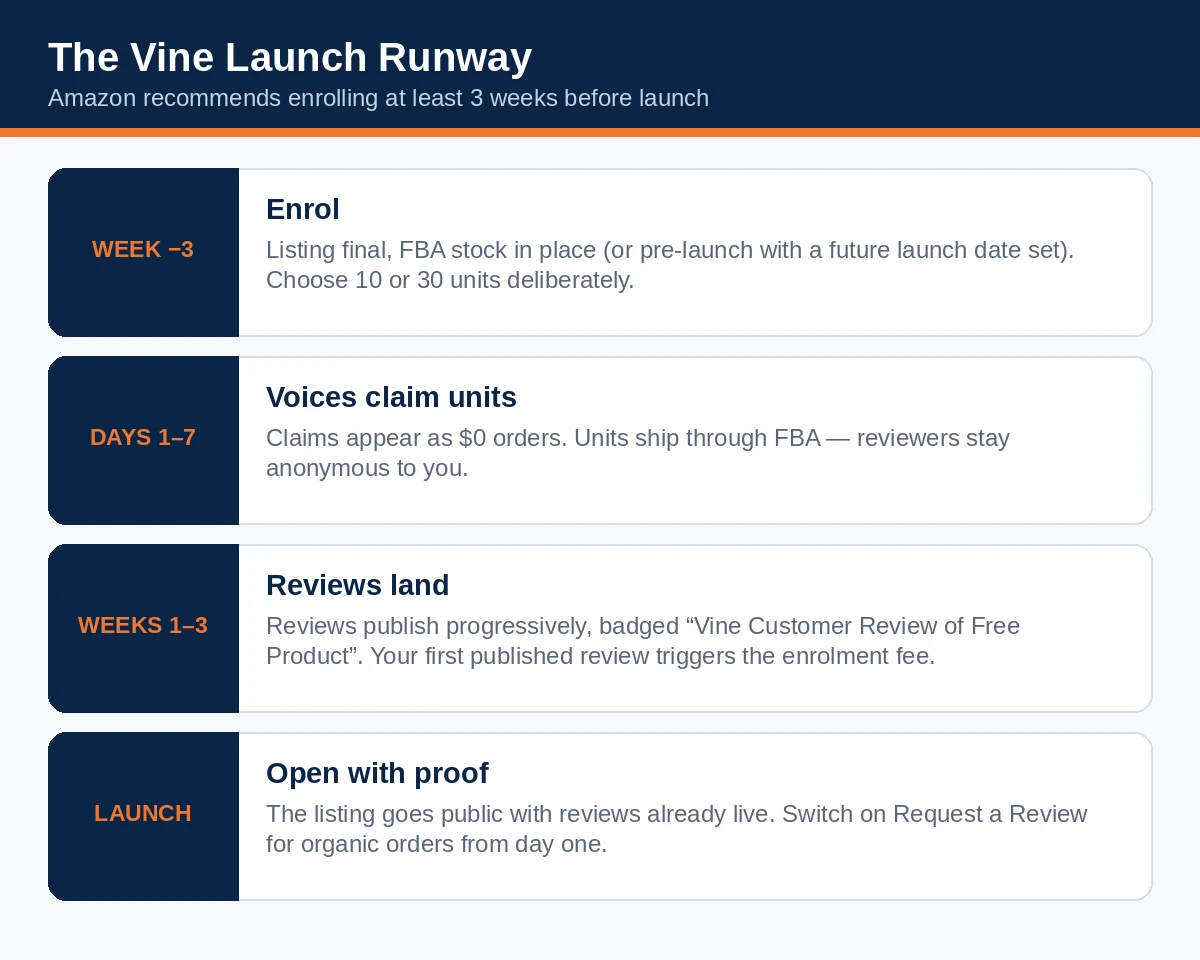
- Prepare the listing and the stock. Finalise the listing (Section 8's readiness list), and get FBA inventory to Amazon. For an unlaunched product, you can enrol as soon as the FBA listing is customer-ready with a future launch date set — reviews can be gathering before the public launch.
- Open the Vine dashboard. Seller Central → Advertising → Vine. Amazon surfaces products it recommends enrolling, or search for your eligible FBA ASIN.
- Choose the parent ASIN and the unit count — 1–2, 3–10 or 11–30 units. The count sets your fee tier (Section 4). Read the fee shown on this screen carefully: it is the operative number for your enrolment (see the fee-report caveat in Section 4).
- Confirm enrolment. The units are committed from your FBA inventory. Voices begin claiming; claims show up as $0 orders.
- Reviews arrive over the following days and weeks. Voices receive the product through Prime delivery and publish on their own schedule. Amazon recommends enrolling at least three weeks before launch, which tells you the realistic pace: this is a runway, not a button.
- Billing follows publication, not enrolment. The fee is charged only after your first Vine review is published — and if no Vine review is received within 90 days of enrolment, no fee is charged at all.
What happens when — the enrolment timeline:
| When | What happens |
|---|---|
| Enrolment day | Units are committed from your FBA stock. The enrolment can still be cancelled — but only until the first unit is claimed |
| Days that follow | Voices claim units; the orders appear in your reports at $0, with no customer identity attached |
| The following days to weeks | Reviews publish progressively, on the Voices' schedule, not yours. The publication of your first Vine review is what triggers the enrolment fee |
| Launch day (if you enrolled pre-launch) | The listing opens to the public with its first reviews already live |
| Day 90 | The backstop: if no Vine review has been received by now, no enrolment fee is charged |
Marketplace note: Vine operates in the US, Canada, the UK, France, Germany, Italy, Spain, Australia and Japan, with local fee tiers (UK: £0 / £60 / £140; EU stores: mid and top tiers at €70 and €170). Everything else in this guide is written on the US programme.
4. The real cost of Vine: fee, free units, and the number nobody budgets
Ask a room of sellers what Vine costs and every hand says "$200". The enrolment fee is the smallest line in the true cost. The full stack, per parent ASIN:
- The enrolment fee: $0 (1–2 units), $75 (3–10 units) or $200 (11–30 units), charged once, only after the first review publishes, and waived entirely if no review arrives within 90 days.
- The free units: every unit a Voice claims is a unit you manufactured, shipped and will never sell or get back. Your cost is the landed cost of goods per unit, times units.
- FBA fulfilment on Vine units: Vine orders are FBA orders, and the fulfilment fee applies to them as it does to paid orders, alongside the inbound shipping you already paid to stock them.
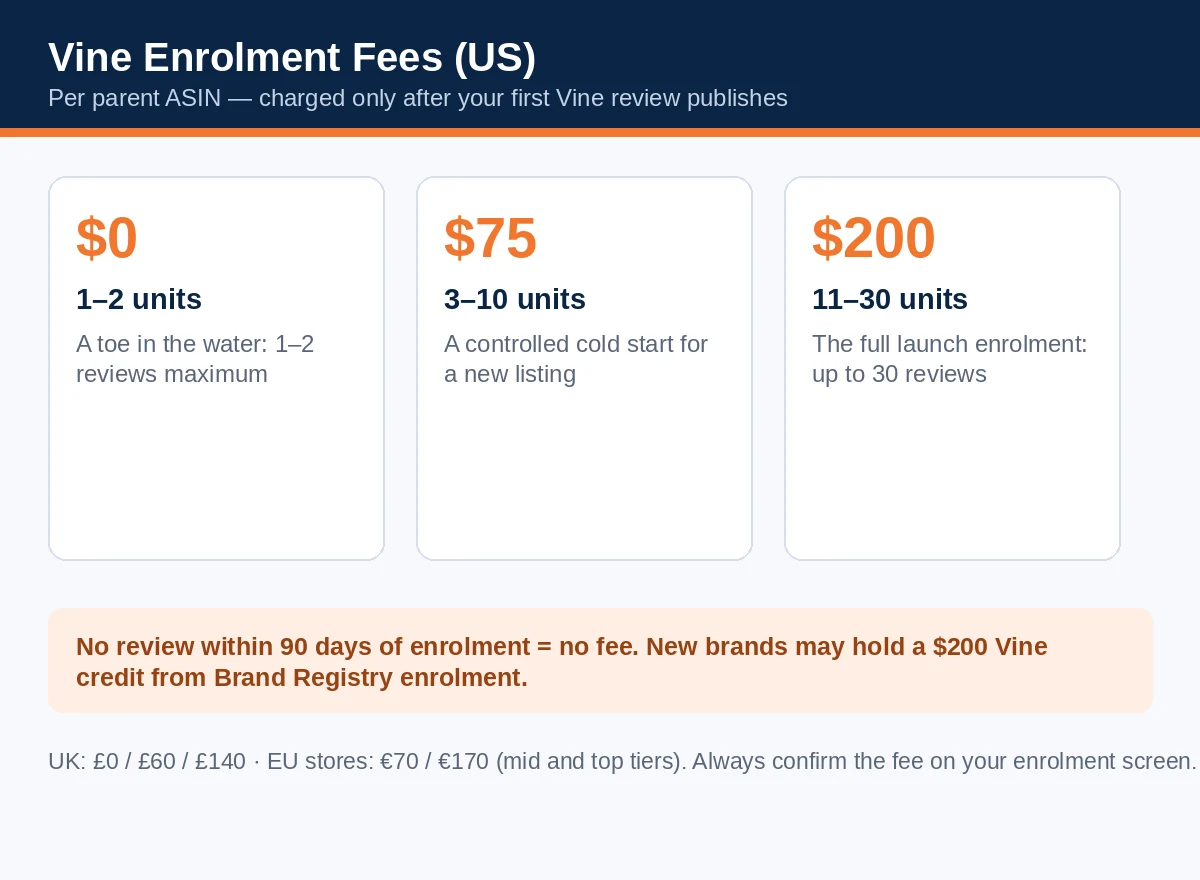
A necessary honesty note on fees. In July 2026, trade press reported that Vine fees for some higher-priced ASINs had risen — figures up to $450 were cited — and that reviewer slots had been cut in some categories. Those reports carried no Amazon source, and Amazon's own Vine page, checked while writing this guide, still lists $0 / $75 / $200 with a 30-unit maximum. Both cannot be universally true. The resolution for a working seller is simple and unglamorous: the fee displayed on your enrolment screen, for your ASIN, is the number that counts. Check it before you confirm, and if it differs from the tiers above, believe the screen.
Worked cost per review. The table below models three typical products. "Unit cost" is landed COGS plus the FBA fulfilment fee. Expected reviews assume 70% of enrolled units end up as published reviews — a planning figure in the middle of seller-reported experience (Section 5), not an Amazon statistic.
| Product | Unit cost (COGS + FBA) | 10 units: total cost | 30 units: total cost | Expected reviews (30 units, ~70%) | Cost per review (30 units) |
|---|---|---|---|---|---|
| A — $14.99 impulse buy | $8.40 ($4.50 + $3.90) | $159 ($75 fee + $84) | $452 ($200 fee + $252) | ~21 | $21.52 |
| B — $29.99 mid-range | $14.80 ($9.60 + $5.20) | $223 ($75 fee + $148) | $644 ($200 fee + $444) | ~21 | $30.67 |
| C — $59.99 premium | $27.80 ($21.00 + $6.80) | $353 ($75 fee + $278) | $1,034 ($200 fee + $834) | ~21 | $49.24 |
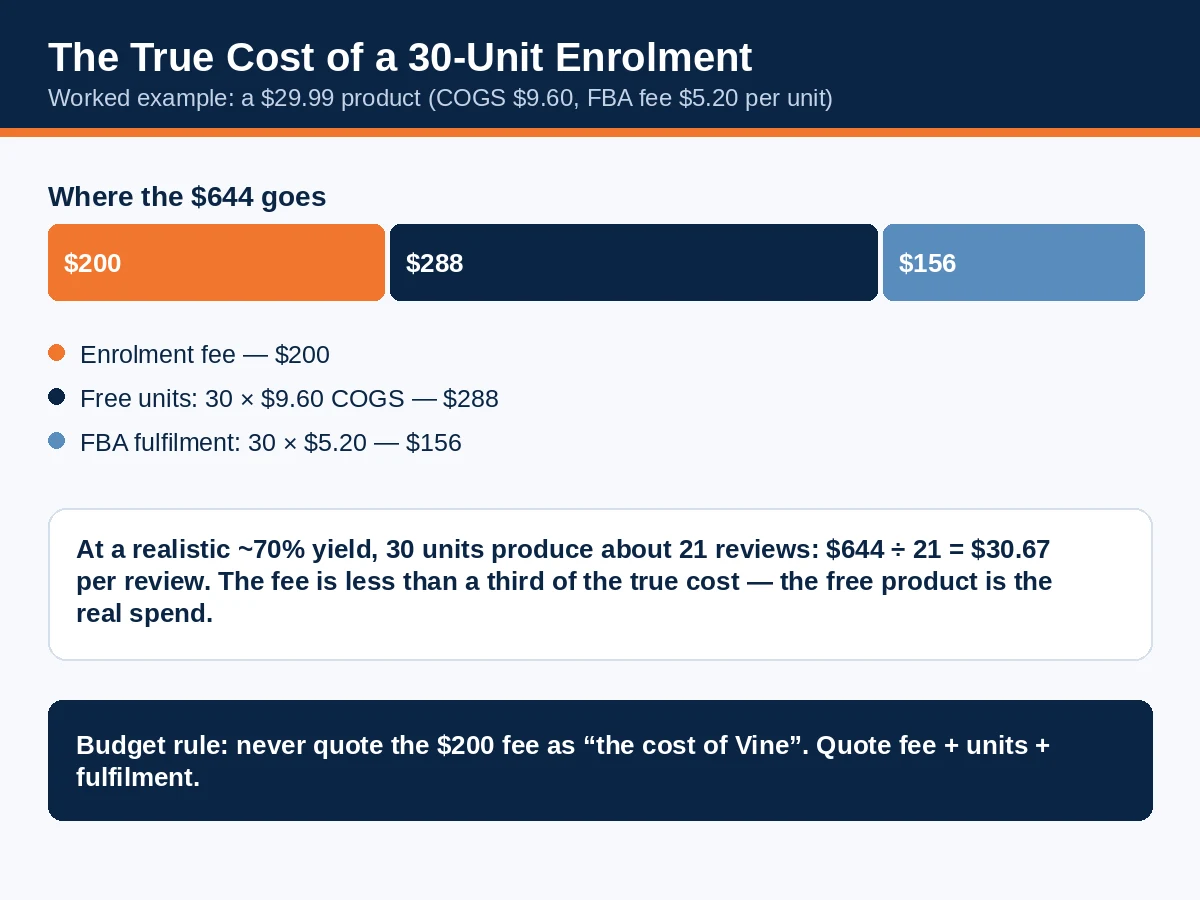
Three lessons fall out of the arithmetic. First, the goods dominate: on the premium product, the $200 fee is under a fifth of the true cost. Second, cost per review barely improves with volume — moving from 10 to 30 units spreads the fee but not the per-unit giveaway cost, so enrol more units for more reviews, not for cheaper ones. Third, cost per review rises with price point — which sounds like an argument against Vine for premium products until Section 7 runs the other side of the ledger: what a review is worth at each price.
Credits can change the maths. Amazon currently offers new sellers who enrol a brand in Brand Registry a $200 Vine credit — which can make the top tier effectively fee-free for an eligible new brand (the goods still cost what they cost). Amazon's New Selection Programme for new FBA products has also carried Vine enrolment credits in 2026. If either applies to you, Vine's economics improve sharply; check your eligibility in Seller Central before paying full price in your planning.
Free download: run your own product through the Vine Cost Worksheet (CSV) — enter price, COGS, FBA fee and margin, and it lays out total cost, cost per review and break-even sales for the 10-unit and 30-unit tiers.
5. How many reviews you actually get — and how long they take
"Up to 30 reviews" is the cap printed on Amazon's page, and the number sellers repeat. Plan on less, for two mechanical reasons: not every enrolled unit gets claimed (Voices choose; an unappealing or very niche product can sit), and not every claimed unit becomes a review on your schedule. Amazon does not publish a claim or completion rate. Seller experience across forums and agency reporting commonly puts the outcome of a full 30-unit enrolment at roughly 18–27 published reviews, with mainstream consumer products at the high end and narrow-niche products lower and slower. The worked examples in this guide plan at ~70% (21 of 30) — deliberately mid-range, neither the brochure figure nor the horror story.
Timing follows the same realism. Claims can begin quickly for attractive products, but reviews arrive over days to weeks, not overnight — hence Amazon's own advice to enrol at least three weeks before launch. Pre-launch enrolment is the pro move the programme now supports: enrol once the FBA listing is customer-ready with a future launch date, and the first reviews can be live on or near launch day instead of trailing it by a month.
Two expectations to set with your team. You will not know who reviewed, and you cannot hurry anyone. There is no dashboard lever, no message channel, no legitimate accelerator — anyone selling one is selling manipulation (our reviews playbook covers what that costs). And the reviews are permanent in the ordinary way: they are normal product reviews with a badge, they age, they get voted helpful or not, and later organic reviews dilute them exactly as they should.
6. The 2026 variation split: the tactic that died, and what replaced it
Until this year, reviews on Amazon were broadly shared across a variation family, and a standard Vine play followed: enrol the parent, let reviews land on one child, and watch the whole family's detail pages show the rating. That play is over.
Announced on 7 January 2026 and rolled out category by category from 12 February to 31 May 2026, Amazon now shares reviews across variations only where the difference is minor — colour, pattern, pack quantity and the like. Functionally different variations carry their own reviews. Amazon has said Vine reviews would be reinstated to their original child ASINs where the split applied, and its seller tooling now checks sharing eligibility per variation.
What this means for your Vine decisions in 2027:
- Enrol the variation you actually intend to sell at volume. Reviews earned by the hero variation stay with it; a cheap sibling no longer subsidises the family.
- Budget per hero ASIN, not per family. If two functionally different variations both need cold-start reviews, that is potentially two enrolments and two sets of free units. The family-level bargain is gone.
- Check how your variations are classified before enroling. Whether your differences count as "minor" decides whether one enrolment covers the set. Our reviews playbook tracks the variation rules in full; verify your family's treatment in Seller Central before committing units.
7. Is Vine worth it? The break-even test
Forget "is Vine good?" — the answer is arithmetic. A Vine enrolment pays for itself if the reviews it produces cause enough additional sales, over the listing's life, to cover the enrolment's true cost. The test:
Break-even extra sales = total enrolment cost ÷ contribution margin per unit sold.
Run it on Section 4's three products, at a full 30-unit enrolment:
| Product | Total cost (30 units) | Margin per sale | Extra sales needed to break even | Reading |
|---|---|---|---|---|
| A — $14.99, $5 margin | $452 | $5.00 | ~90 sales | Hard work: a cheap product must move real volume for reviews to repay |
| B — $29.99, $11 margin | $644 | $11.00 | ~59 sales | Plausible over a launch quarter for a decent product |
| C — $59.99, $24 margin | $1,034 | $24.00 | ~43 sales | The easiest case: premium products repay Vine fastest |
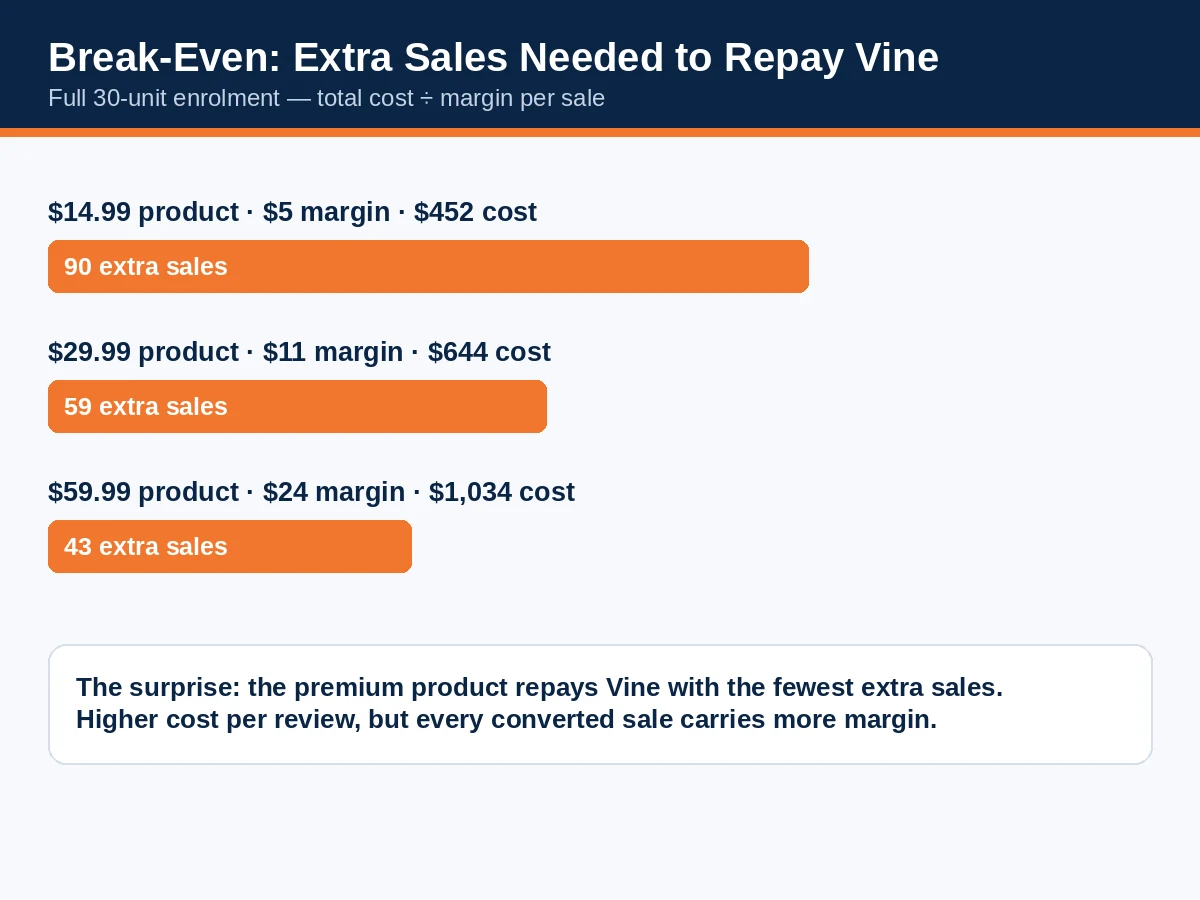
The pattern surprises most sellers: *the premium product, with the highest cost per review, needs the fewest extra sales to justify Vine*, because every sale it converts carries more margin. The impulse-buy product faces the steepest climb — 90 extra sales from ~21 reviews is a real demand on a listing that, by definition, is just starting. This is why experienced sellers treat Vine as near-automatic above roughly $25–$30 price points with healthy margins, and as a genuine question below them.
Apply the test honestly, with two adjustments. First, the benefit side isn't only the break-even sales: reviews also lift conversion on all subsequent traffic (including the advertising you were going to run anyway — ads convert better on a reviewed listing) and they carry information value: 20 detailed early reviews are the cheapest product-research panel a brand can buy, and catching a fixable flaw in week two is worth money the table doesn't count. Second, run the same test for the 10-unit tier: at $159–$353 total, break-even falls to roughly 15–32 extra sales — a legitimate middle path when the full enrolment fails the test but the product still needs a cold start.
Enrol Vine when: the product is retail-ready and genuinely good (Section 8); the break-even number is a small fraction of the sales you reasonably expect in the first quarter; and reviews — not traffic, not the product itself — are the bottleneck. Skip or shrink Vine when: margins are thin and price is low; the product still has known flaws (Vine will document them, credibly, at launch); the listing would convert poorly even with reviews (fix the listing first — it is free); or the ASIN is approaching 30 reviews organically anyway.
And place Vine among its alternatives honestly: Request a Review is free and compliant but needs sales you don't yet have; Amazon Ads' newer review-request products are promising but early; doing nothing costs nothing and yields nothing. Vine is the only lever that produces reviews before meaningful sales. That is what the fee buys.
The decision at a glance:
| Your situation | Recommendation |
|---|---|
| Proven product, $30+ price, healthy margin, launching in 3+ weeks | Enrol 30 units — break-even is a small fraction of a normal launch quarter |
| Good product, first launch, quality not yet proven by sales | Enrol 10 units — buy the information and the cold start at a third of the giveaway cost |
| New brand eligible for the $200 Vine credit | Enrol 30 units — the fee is covered; your only real cost is the units |
| Low price (under ~$20) with thin margins | Run the break-even test first — at ~90 extra sales needed, Vine is the hardest to justify here; 10 units or skip |
| Known product flaw, listing not final, or launch is this week | Skip for now — fix the product or listing first; a rushed enrolment documents flaws credibly and permanently |
8. Mistakes that waste an enrolment (and the launch sequence that doesn't)
The enrolment fee is small. The wasted launch is not. The recurring disasters:
- Enrolling before the product is retail-ready. Voices review what arrives: the unit, the packaging, the instructions, exactly as a customer meets them. A fixable defect, a confusing manual, a listing that overpromises — Vine converts each into detailed, credible, permanent launch-day evidence. Enrol the product you would proudly hand to a hostile reviewer, because that is the job description.
- Enrolling before the listing is final. Title (75 characters, per the current rules), images, bullets and price should be the versions you intend to sell with. Reviews earned against a listing you then substantially change are reviews of a product shoppers can no longer quite buy.
- Enrolling the wrong variation — see Section 6. Post-split, this is the most expensive clerical error in the programme.
- Defaulting to 30 units on an unproven product. If you have never sold the item, a 10-unit enrolment buys most of the information at a third of the giveaway cost. Reserve 30 for products whose quality is proven — including by a smaller Vine round or prior sales elsewhere.
- Treating Vine as a rating purchase. Some reviews will be lukewarm or negative, and there is no appeal, refund or remedy for an honest 3-star. Budget emotionally as well as financially: the programme buys credible reviews, and credibility includes the spread.
- Trying to touch the reviewers. Contacting, incentivising or attempting to identify Voices — directly or through a service — converts a legitimate programme into manipulation, with the account consequences our playbook details. It is also structurally near-impossible: you don't know who they are.
- Letting Vine eat your launch stock. Vine claims draw on the same FBA inventory as paying customers. Enrol 30 units against thin stock and your launch can sell out to reviewers while your ads are still warming up — reserve the units mentally as marketing stock, and stock the launch on top of them.

The clean launch sequence: (1) Brand Registry in place, trademark path started months ahead. (2) Listing finalised and product QC'd. (3) FBA inventory inbound; enrolment submitted about three weeks before launch (pre-launch, with the launch date set). (4) Launch with the first reviews landing; Request a Review switched on for every organic order from day one. (5) Read the Vine reviews like a product panel: fix what's fixable, answer nothing (you can't), and let the rating they establish carry your early advertising.
9. FAQ
How much does Amazon Vine cost in total?
The enrolment fee is $0 / $75 / $200 depending on units (1–2 / 3–10 / 11–30), charged only after your first Vine review publishes and waived if none arrives within 90 days. The true cost adds the units themselves: at 30 units, modelled totals run from about $452 (a $15 product) to about $1,034 (a $60 product), or roughly $21–$49 per review received. Work your own numbers with the worksheet that accompanies this article.
Can I use Vine without Brand Registry?
For branded products, no — a Brand Representative or Reseller role on a Brand Registry brand is required, on a Professional plan. Eligible generic (unbranded) products can qualify without a brand; the Vine dashboard shows what your account can enrol.
Can FBM sellers use Vine?
No. Vine units are fulfilled by Amazon — that is how reviewer anonymity is protected — so an FBA offer with available inventory is required.
How many reviews will I get from 30 units?
Up to 30 is the cap, not a promise. Units must be claimed, then reviewed; seller experience commonly lands around 18–27 published reviews from a full enrolment, with niche products lower and slower. Plan your economics at around 70% and treat anything above as upside.
Are Vine reviews guaranteed to be positive?
No — and this is the point of the programme's credibility. Voices review honestly, ratings spread, and you cannot appeal an honest low rating. Enrol products you are confident in.
When is the enrolment fee charged?
After your first Vine review is published (not at enrolment). If no Vine review is received within 90 days of enrolment, the fee is not charged.
Can I enrol the same product twice, or top up later?
Treat enrolment as a single deliberate decision per parent ASIN: choose the tier you actually want up front, and check the dashboard for what your ASIN currently allows before assuming a second enrolment is available. Cancelling is only clean before any unit is claimed.
I'm in the UK or the EU — are the fees different?
Yes, the tiers are local: UK enrolment is £0 (1–2 units), £60 (3–10) or £140 (11–30); in the EU stores the mid and top tiers are €70 and €170. The structure — per parent ASIN, charged after the first review publishes — is the same, and Vine also runs in Canada, Australia and Japan with their own local pricing. As everywhere: the fee on your enrolment screen is the operative number.
Does Vine work for products that are already selling?
Only while the detail page has fewer than 30 reviews. Past that, the ASIN is ineligible — Vine is launch infrastructure, and products beyond it graduate to Request a Review and organic velocity.
Over to you: what did Vine do for your launch?
If you've run a Vine enrolment, the numbers this community needs are yours: what did you enrol, how many units, how many reviews actually published, over how many weeks — and knowing the cost now, would you enrol the same product again at the same tier? Post the arithmetic, not just the verdict. If you're deciding on a first enrolment, post your price point and margin and let the break-even test in Section 7 be argued with in public — that argument is the most useful review this article will ever get.
Read next: Vine is one chapter of the full reviews system — How to Get Reviews on Amazon in 2027: The Complete TOS-Safe Playbook covers every compliant channel and the law around them. And once reviews land, buyers start rating you: Amazon Seller Feedback: The Complete Guide covers the other score. If your listing still needs its title fixed before enrolment, start with the 75-Character Title Rule guide.